
Listen to this story · 6 min · narrated with an AI voice
On a trip through downtown Madison, a high school student became someone younger learners turned to for help. He knew about navigating the city and riding the bus, and Kristin Jean Grender made room for that knowledge to guide the group. In her account of the experience, younger students began asking him questions, and he later asked to help teach them again. A community lesson had opened another possibility: a learner could recognize himself as someone with something valuable to teach.
What they made happen
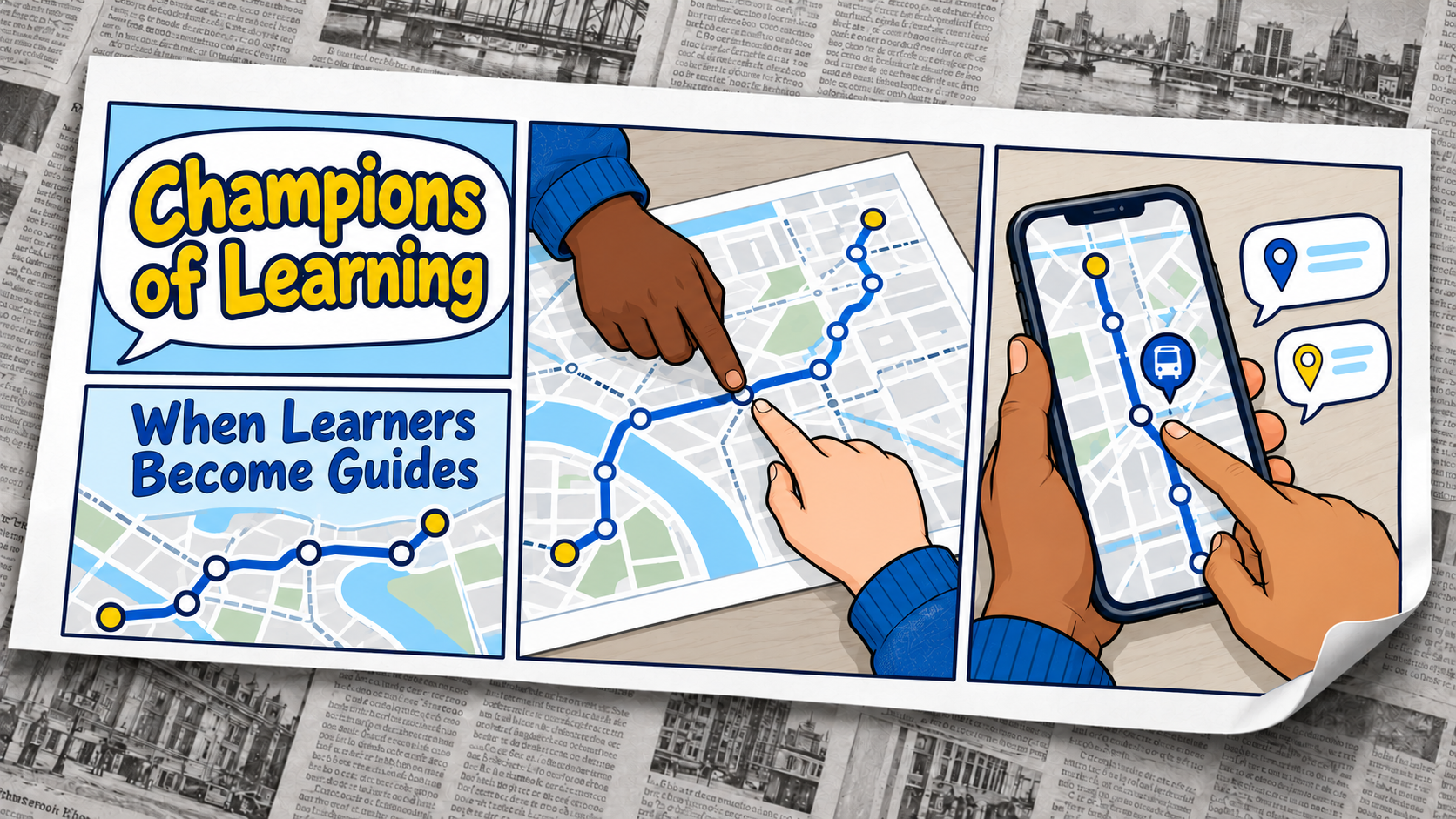
Grender describes the outing in a chapter she is writing, Finding Another Way In: Creating Access, Opportunity, and Independence. The group practiced orientation and mobility skills while using public transportation in Madison, Wisconsin. Students used phones and maps, practiced street crossings and bus travel, and explored NaviLens at the Orpheum Theater. A stop for pizza and the return bus journey were part of a day in which learning had an immediate purpose: getting somewhere together.
An older student brought more experience with city travel and buses than some of the younger learners. As he contributed information, Grender noticed an opportunity to let his expertise matter. She gave him space to explain, and younger students asked him questions. The exchange grew from knowledge he already had and a real need other learners encountered.
Grender reports that his confidence grew during the experience. Afterward, he asked whether he could help teach younger students again and discussed becoming a special education paraprofessional after graduation. That conversation was a possibility he could imagine, not a claim that he had already entered that profession. The documented contribution is meaningful on its own: he helped peers and wanted to do more of it.
Meet the educator
Kristin Jean Grender works with CESA 2 in southern Wisconsin, supporting access and opportunity for learners who are blind, low vision (BLV). Her account places students’ knowledge, participation and independence at the center of the work. She looks for ways learners can contribute to the experience as well as receive instruction.
Her work also includes collaboration on the iDATA astronomy accessibility project. In her chapter, she describes initially hesitating because astronomy was outside her expertise. The project needed the knowledge she brought about access for learners who are blind, low vision. Students, educators, scientists and programmers contributed to the wider effort, including testing lessons and offering feedback. Its collaborative nature matters: access develops through the knowledge of many people, including the learners using the materials.
What went into it
The Madison experience combined deliberate instruction with responsiveness. Grender had organized a community learning opportunity with practical travel tasks. Within that structure, she noticed a student’s relevant experience and allowed the teaching relationship to expand. She remained the educator while making room for a learner to explain what he knew.
That choice gave the older student an authentic audience. His contribution could help another person understand the next part of the journey. The younger students also contributed by asking questions and seeking his knowledge. Their participation helped make the exchange a learning relationship, rather than simply an assigned leadership role.
The lesson is not that adults should withdraw support. Community travel instruction requires preparation, appropriate supervision and attention to individual access needs. The opportunity came from recognizing where a learner could contribute within a supported experience. Grender’s account invites educators to notice expertise that may become more visible when learning moves into a meaningful setting.
Why it matters
Students deserve opportunities to experience their knowledge as useful to someone else. In this account, helping younger peers gave one student a reason to consider teaching again. Grender’s contribution was to recognize that opening and make space for it. The story does not establish a long-term outcome for every participant, but it shows a concrete moment when a learner’s expertise became a resource for others.
Research offers a broader reason to make room for students to teach. A meta-analysis published March 4, 2025, in Educational Psychology Review by researchers at Vanderbilt University and the University of Texas at Austin found positive average academic effects for both tutors and younger learners in cross-age tutoring programs. Teaching can create a learning opportunity for the student offering help as well as the student receiving it. The study examined school-based academic tutoring, however, not community travel instruction. It provides context for Grender’s approach without proving the effects of her students’ experience.
Bring the idea to your classroom
Begin by asking what learners already know that could help someone else. Offer a supported opportunity to explain a useful skill, rehearse with a partner and respond to questions. Keep participation voluntary, make materials accessible and gather feedback from both learners. A school-based task can provide a manageable starting point before considering more complex community activities.
Help Me Try This
The two-page teacher guide, When Learners Become Guides, includes a suggested activity, accessibility supports, reflection questions and three optional AI planning prompts. It is a Champions of Learning adaptation inspired by Grender’s account, not a reproduction of her procedure or an endorsed resource.
Sources: Kristin Jean Grender’s chapter in progress, Finding Another Way In: Creating Access, Opportunity, and Independence; her Varkey Q&A; Global Teacher Prize profile; and the linked 2025 meta-analysis. The community experience and student response are attributed to Grender’s account.
Champions of Learning · Story card
Champion of Student Expertise
Kristin Jean Grender
Educator · CESA 2, southern Wisconsin
Editorial takeaway
Give learners supported opportunities to use what they know to help someone else learn.
Explore more educator stories.