
Listen to this story · 9 min · narrated with an AI voice
What they made happen
Technology can open a doorway to a place we might never otherwise explore. Visiting in person offers experiences that a virtual environment cannot fully replace, but spatial virtual reality invites new possibilities: sharing a landscape across distance, returning to a moment of change, and creating connections that extend beyond a single visit.
When we treat technology as a partner to our creativity, we can begin to imagine differently. What could students preserve, explain or invite someone else to experience? For Colleen O’Rourke, those possibilities connect digital learning with a world worth exploring.
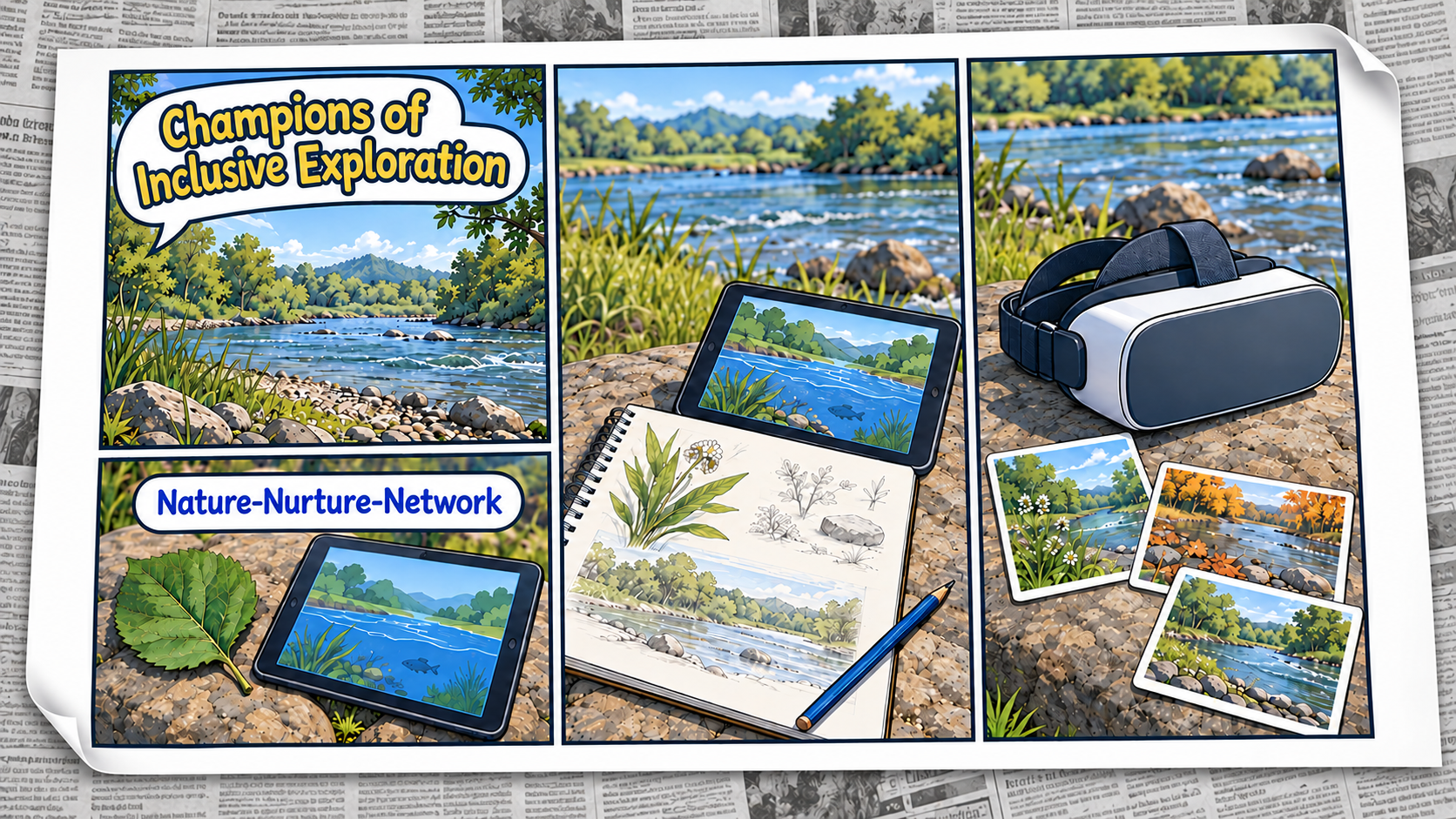
Her students have been building a virtual-reality archive of restoration along the Onkaparinga River, according to her Global Teacher Prize profile. The planned ten-year record gives students a way to connect digital creation with a changing landscape. The archive is still in development, with the ambition of allowing people to revisit the river’s restoration over time. [1]
The archive belongs to Nature-Nurture-Network, an approach O’Rourke says is embedded throughout HILLS’ redeveloped Foundation to Year 10 Digital Technologies curriculum. Students explore trees and mycorrhizal networks as an analogy for understanding internet networks, bringing questions about connections in nature into their study of technological systems. The purpose is to help learners understand the world they are designing for, as well as the tools they use. [1, 2]
Meet the educator
O’Rourke is Leader of Digital Innovation at HILLS Christian Community School in South Australia. In her review, she describes welcoming visiting educators and school leaders to the Innovation Centre, serving as Vice President of EdTechSA and teaching Digital Technologies to pre-service teachers as an adjunct lecturer at Tabor College. Sharing the approach beyond her own school is part of the work she values. [2]
Her Schools Plus profile describes a Digital Innovation Centre within the school’s nature-play space, alongside a commitment to learners with different strengths and support needs. Adaptive technologies are part of that approach. The educator’s contribution is in designing opportunities to participate and contribute, not simply making new equipment available. [3]
What went into it
At HILLS, the Digital Leadership Program gives students opportunities to mentor younger learners, share expertise and practice public speaking. O’Rourke describes virtual-reality and digital-storytelling collaborations with communities in rural Australia, the United States, Afghanistan and New Zealand. Schools Plus also identifies work with Nyangatjatjara College near Uluru. The students and partner communities contribute their own environments, cultures and experiences to these exchanges. [2, 3]
That shared effort matters at the river, too. O’Rourke credits Nature Science Educator Cavan Newble with supporting ecological investigations; Dr Paul Unsworth, formerly at the University of South Australia and now at Charles Sturt University, with academic collaboration; and Rosanna Cotino of EdgedVR with helping students develop their immersive-creation skills. HILLS students are the investigators, designers and storytellers whose questions give the projects direction. [2]
O’Rourke’s additions bring the river work into sharper focus. Students investigate rabbit populations, invasive weeds and restoration, and learn about cultural practices such as cool burning. They collect annual water-quality data, including pH and turbidity, and create immersive tours that she says have been shared nationally to draw attention to the restoration work. These are current activities within an archive intended to grow over time, not a completed ten-year record. [2]
One investigation began with a change in the numbers. O’Rourke reports that students noticed seasonal fluctuations in river pH and asked what might explain them. They explored a possible connection with runoff from nearby land use. That connection remains a hypothesis in the evidence supplied for this story, not an established cause. The learning opportunity was in taking an observation seriously enough to investigate it, while keeping a proposed explanation open to further testing. [2]
Students also manage projects, design virtual environments and develop 2D and 3D AI avatars to help tell the river’s evolving story, according to O’Rourke. They are deciding how another person will encounter a place and understand its changes. Creating that experience asks more of them than simply viewing a finished virtual tour. [2]
In a student-team reflection supplied by O’Rourke, the learners wrote, “As we gained a further understanding of this project and its deep importance we found ourselves more and more engaged.” Another reflection expressed a hope that the VR project would help others understand both the technology’s place in schools and the importance of preserving nature. These comments offer a glimpse of students’ engagement and intentions; they do not establish how audiences responded or measure the project’s wider impact. [2]
Why it matters
For O’Rourke, nature is more than a backdrop. It offers relationships, patterns and changing systems that students can investigate, represent and explain. Her aim is for their growing digital skills to serve a purpose they care about. A river’s changing chemistry becomes a question to pursue; a virtual environment becomes a way to invite someone else into that investigation. The students’ work gains an audience beyond the teacher, while its explanations still have to answer to evidence. [2]
O’Rourke clarifies that her ongoing university-linked action research focuses on student engagement and creativity through student-created immersive VR storytelling. Nature-Nurture-Network provides the broader educational framework; immersive storytelling is the specific research focus. The underlying action research has not been independently reviewed for this story, so its outcomes are not presented here as independently established findings. [2]
Research she suggested offers relevant context. A 2026 study of 40 gifted sixth graders reported greater gains in engagement, self-regulation and scientific creativity with immersive VR-supported science instruction than in its comparison group. [4] A separate study of high school and university students found higher engagement and knowledge mastery with an immersive historical narrative than with a 360-degree video version. [5] These studies help frame questions about immersive experiences and engagement. Neither evaluates O’Rourke’s curriculum or establishes the effects of students creating their own VR stories.
Bring the idea to your classroom
O’Rourke encourages educators to think like an ecologist: start small, notice deeply and build complexity over time. Invite learners to observe a tree, an ant colony or a local waterway, then ask what parts are connected and what might change. Her revised companion guide turns that direction into an open-ended investigation that can be adapted across year levels. [2]
Let learners choose how to represent what they find: a drawing, a spoken explanation, a mind map, a stop-motion animation, a coded model or a virtual environment. O’Rourke suggests introducing more complex digital tools as understanding grows. The tool should follow the learning purpose and students’ access needs.
Return to the place or evidence, compare observations and revise the explanation. What did students actually notice? What are they inferring? What would they need to investigate next? The aim is to give curiosity somewhere to go and a meaningful way to be shared.
O’Rourke’s work invites a broader view of digital learning: a means of examining a shared world, contributing to its record and helping someone else participate.
Help Me Try This
Download the revised teacher adaptation guide (PDF). A Champions of Learning adaptation inspired by this work, revised with Colleen’s feedback, with an open-ended systems investigation, three optional AI prompts and a creation-tool guide.
Sources and credits
[1] Global Teacher Prize, Colleen O’Rourke, December 5, 2025. Award-profile account. Read source.
[2] Colleen O’Rourke’s October 2026 correspondence, October 24 review-document additions and comments, and revised Notice, Record, Revisit guide. Educator-supplied primary account; student reflection supplied by O’Rourke.
[3] Australian Schools Plus, Colleen O’Rourke. Undated Teaching Fellow profile, checked October 24, 2026. Read source.
[4] Yunus Emre Avcu and Yavuz Yaman. “Differentiated Science With IVR: Effects on Gifted Students’ Engagement, Self-Regulation, and Scientific Creativity.” Gifted Child Quarterly, 2026. Abstract reviewed. Read source.
[5] James Calvert and Rhodora Abadia. “Impact of Immersing University and High School Students in Educational Linear Narratives Using Virtual Reality Technology.” Computers & Education, vol. 159, 2020, article 104005. Abstract reviewed. Read source.
Champions of Learning · Story card
Champion of Inclusive Exploration
Colleen O’Rourke
Leader of Digital Innovation | HILLS Christian Community School, South Australia
Editorial takeaway
Begin with a world learners can explore, then choose tools that help them contribute.
Explore more educator stories.


