
Listen to this story · 8 min · narrated with an AI voice
At the end of another frustrating class, Steve Fouts brought a student into the hallway. The experienced teacher had been struggling to reach him, and their encounters had become confrontations. Then Steve asked, “What’s wrong?” The student told him he had witnessed his father’s murder. He was carrying a grief Steve had not understood. Standing with the student he thought he knew, Steve realized how much he had missed. The behavior that had felt directed at him belonged to a life he had barely begun to understand.
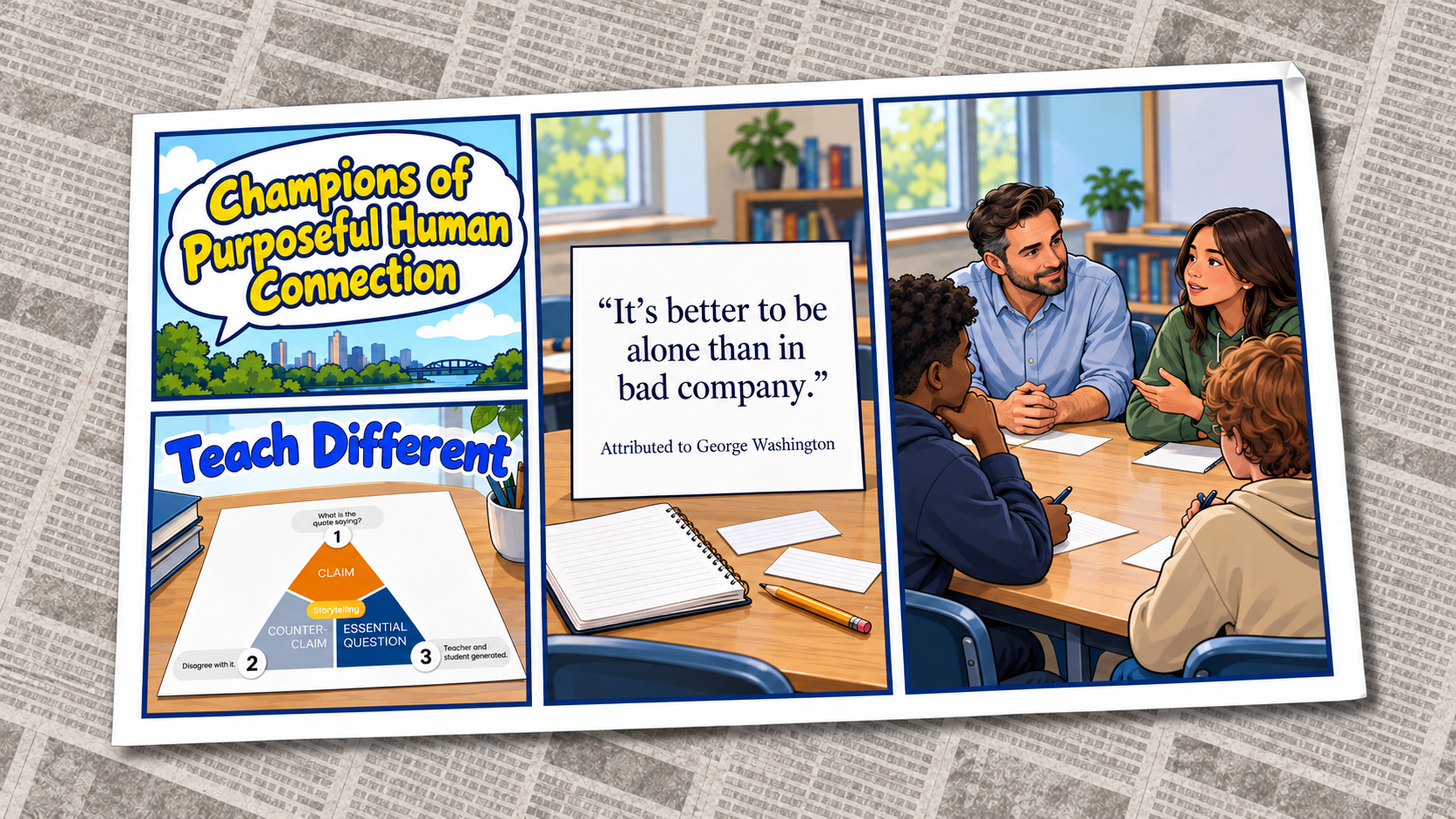
The next day, Steve put a quotation about revenge on the board, handed out slips of paper and invited the class to respond. The student began contributing. Other students shared their thinking and experiences. Steve remembers the conversation continuing until the bell, when no one moved to leave. He tried another quotation the following day. That decision to make room for conversation became a starting point for Teach Different, the work he developed with his twin brother, Dan.
What they made happen
Through Teach Different, Steve and Dan have made purposeful conversation a practice educators can learn, rehearse and bring into their lessons. Their framework gives teachers a starting point for helping students interpret an idea, consider a competing perspective and investigate a question together.
The contribution is practical: a structure for acting on the belief that relationships matter. Rather than leaving connection to an occasional memorable exchange, the brothers give educators a way to plan for it. Their podcast models conversations, while their professional learning community gives teachers a place to continue developing the craft.
The question their work raises feels particularly relevant in an age of AI: what opportunities will schools deliberately protect for students to think with, listen to and come to understand other people?
Meet the educator
Dr. Steve Fouts and Dan Fouts bring different classroom experiences to that shared purpose. Steve’s background includes teaching mathematics and humanities across school and college settings, with much of his career spent on Chicago’s west side. Dan’s experience includes teaching government, philosophy and U.S. history in the Chicago area.
Their professional paths also connect education and philosophy. Steve earned a doctorate in education from Benedictine University. Dan studied political science and philosophy at Bradley University before completing graduate work in education and social policy at Northwestern.
Together, they have built a project around a recognizable teaching challenge: creating an environment where students can express an idea, encounter disagreement and remain willing to listen. The educator’s preparation makes that invitation possible.
What went into it
Steve’s account of the student matters because it includes his own reconsideration. In a later podcast retelling, he acknowledges that he had interpreted the student’s behavior as an obstacle to doing his job. Learning more about the student made him recognize the limits of that judgment.
The change was more durable than finding a successful discussion prompt. Steve began approaching students as people whose thinking he needed to understand. In that later account, he recalls bringing the experience to Dan as evidence of how much a conversation could reveal.
The brothers developed a structure around that possibility. Earlier Teach Different materials describe three steps: claim, counterclaim and essential question. The current website presents four moves, explicitly including storytelling. Across those descriptions, the central work remains examining an idea from more than one direction and connecting it with meaningful questions.
Teachers also need opportunities to experience that work themselves. An NCSS workshop featuring Teach Different asks participants to observe and analyze a demonstration, discuss classroom applications and choose a conversation to try. That sequence recognizes facilitation as a skill requiring practice.
Why it matters
The human side of teaching includes noticing when a student’s first response conceals a more complicated understanding. It includes making room for an unfinished thought and helping classmates consider it seriously. These responsibilities require attention during the exchange, as well as preparation beforehand.
AI gives this story a timely frame. Whatever technologies a school adopts, educators still have decisions to make about when students will address one another, whose ideas will receive attention and how disagreement will be handled. A commitment to human connection becomes more useful when it has time, routines and teaching strategies attached to it.
Research from Illinois State University offers a related reason to make room for purposeful conversation. In a February 12, 2025 university report, Harriett Steinbach and colleagues described research on Deliberative Dialogues, a program in which trained facilitators guide students through difficult issues using discussion ground rules. Drawing on student and facilitator surveys and instructor focus groups, the team reported findings consistent with students considering multiple perspectives, learning from others and building a sense of community.
The report concerns college students in Illinois State’s program, rather than Teach Different, and described journal publication as a future step. Its relevance here is the attention to facilitation: creating a useful conversation involves preparation, structure and care for participants. That connection reinforces the value of Steve and Dan’s emphasis on educators practicing the craft together, with colleagues who can help them reflect on what happens in the room.
Bring the idea to your classroom
An educator adapting the brothers’ approach could begin with a brief, carefully sourced quotation connected to the curriculum. Allow time for private thinking before inviting students to explain its claim. Ask them to consider a defensible counterclaim, then identify a question worth exploring further.
Plan for listening as deliberately as speaking. Invite students to explain a peer’s reasoning before adding their own. Offer writing, partner rehearsal or additional processing time so participation has more than one entry point. Personal stories can be welcome without becoming an expectation to disclose painful experiences.
These are editorial suggestions inspired by the work, rather than a reproduction of the brothers’ training. Afterward, a teacher might note whose ideas were taken up, which perspectives remained unheard and what needs a follow-up conversation.
Steve’s encounter with the student gives that planning a human purpose. A teacher reconsidered what he believed he knew about a student. With Dan, he helped turn the importance of that encounter into a practice other educators could learn. Making room for such understanding deserves a place in the daily work of school.
Help Me Try This
Download A Quote Opens the Conversation, the two-page teacher guide (PDF)
Sources and further reading
Steve Fouts, The Story of Teach Different, January 11, 2020
Steve and Dan Fouts, podcast discussion revisiting the student story, approximately 29:53 onward
Teach Different: current framework
Steve Fouts: educator profile
Dan Fouts: educator profile
NCSS: Teach Different workshop
Illinois State University: Deliberative dialogues revisited, February 12, 2025
Champions of Learning · Story card
Champions of Purposeful Human Connection
Dr. Steve Fouts & Dan Fouts
Co-founders · Teach Different · Illinois, United States
Editorial takeaway
Human connection deserves a place in the lesson plan, with time and strategies for students to listen, question and think together.
Explore more educator stories.