
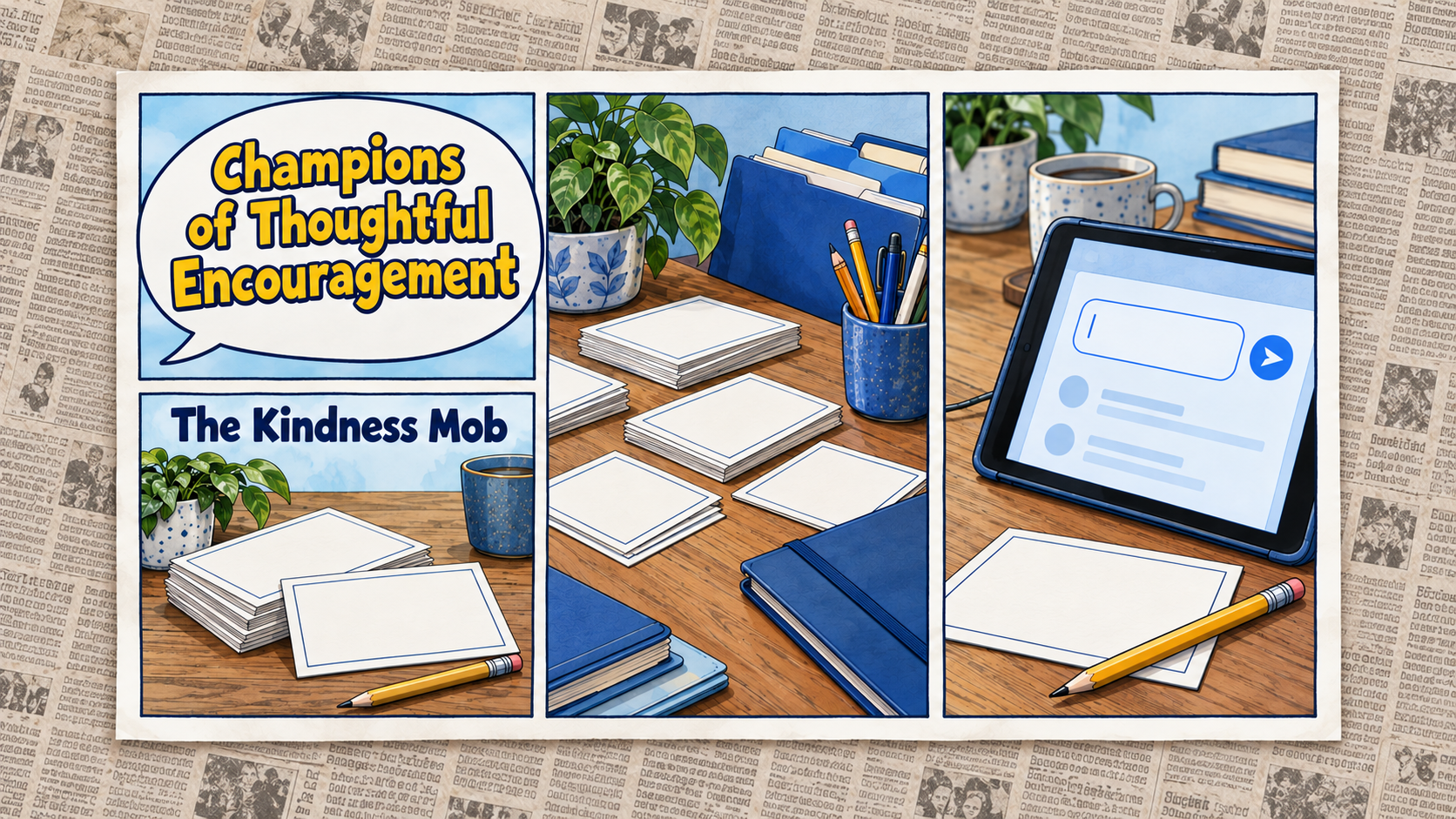
AI-generated conceptual editorial illustration. Not a depiction of an actual workspace.
Listen to this story · 7 min · narrated with an AI voice
Ten people and a screenshot. That was the modest beginning Tyler Brickley described in a North Dakota Nice interview about The Kindness Mob. He wanted a small group to show up for someone online with encouragement. The idea gave people troubled by cruelty in comment sections something concrete to do together: pay attention to another person and choose words that offered support. What began as a small invitation became a volunteer community built around practicing a different response. [1]
What they made happen
The Kindness Mob organizes people to visit a nominated creator's content and leave genuine, encouraging comments. Participants find the invitations through social posts or email. Their contribution is personal: watch, notice something worth appreciating and write it in their own words. The organization's instructions reject copied comments, bots and manufactured praise. [2]
That design leaves an important responsibility with each participant. Someone else can identify the opportunity, but the person commenting still has to look and decide what to say. The activity asks for attention before encouragement. For educators considering learning beyond a classroom, that is a useful distinction: participation involves making a choice about how to treat another person.
Kahri Salyars told CBS News that supportive comments helped restore her confidence after online insults. [3]
Her account offers a human response to the work, rather than a measurement of what every participant learns. The opportunity Brickley has organized is visible in the practice itself: people can contribute to an online conversation without joining its cruelty.
Meet the educator
Brickley founded The Kindness Mob on January 1, 2023. On the organization's About page, he describes becoming saddened by online hostility and wondering whether people could be encouraged to follow kindness as readily as they followed mean comments. [4]
His contribution here is community organizing. He creates an invitation, helps direct collective attention and gives participants a practice they can repeat. This is informal learning through participation, not a documented school curriculum. Its relevance to educators lies in a familiar challenge: helping people move from believing that kindness matters to deciding what it looks like in a particular situation.
The project's mission includes people with whom participants disagree. That makes the invitation more demanding than simply praising friends. It asks whether respect can remain a starting point when agreement is absent. [1, 4]
What went into it
The invitation to comment is brief. The preparation behind choosing a creator is more involved.
In that interview, Brickley credited Nick with building the website and nomination system, Connie with reviewing nominations and helping choose recipients, and Katie with supporting the idea early on. He described several rounds of nomination review and acknowledged the emotional burden of reading difficult accounts. Those contributions help explain how an apparently simple action depends on other people's sustained work. [1]
The nomination page also sets expectations. It describes a preference for people with smaller audiences and limited support, while generally avoiding nominations involving close personal connections, direct requests for money or very large followings. These are preferences with exceptions, not absolute exclusions. [5]
The same page acknowledges that the group receives more nominations than it can select. It presents the activity as a symbolic demonstration of collective action rather than a service everyone can expect to receive. That boundary matters. Organizing care includes being honest about what a volunteer group can offer and what remains beyond its capacity. [5]
Why it matters
A comment is addressed to one person, but other people can read it too. It contributes to what a conversation appears to welcome. Brickley's work makes that ordinarily small act available as a deliberate shared practice.
Research helps explain why comment sections deserve attention. In an April 6, 2026 working paper listed by Columbia Business School, Dante Donati and Lena Song examined social-media comments through a Facebook field experiment and a complementary survey experiment. Their findings distinguished platform engagement from attitudes and behavior beyond the platform. Opposing comments increased online engagement while undermining the influence of the original message; supportive comments had little effect on engagement. [6]
The paper did not evaluate The Kindness Mob, and its findings do not establish that kind comments stop bullying. Its useful connection is more precise: counting reactions is not the same as understanding what readers take away. For a community centered on encouragement, the questions worth asking include how people experience that encouragement and what participants learn about their own choices.
Bring the idea to your classroom
As an editorial adaptation, begin in a teacher-managed space. Invite learners to respond to a willing partner's work, a class contribution or a fictional example. They do not need public social-media accounts or exposure to abusive content to examine what a thoughtful response can do.
Ask them to identify something specific they noticed before writing encouragement. Compare a generic compliment with a response that recognizes an actual choice, effort or contribution. Discuss what makes each response honest and useful, and let the recipient choose whether to receive or discuss feedback.
Then make room for reflection. What did you notice because you took time to look? How did you decide what to say? How might encouragement differ from agreement? Keep the sharing boundaries clear, provide private or spoken alternatives and follow school reporting procedures when actual harassment arises.
The lesson is not that every online problem can be solved with a compliment. It is that people can practice contributing something more thoughtful than the response a crowded comment section appears to expect. Brickley has given that practice a place to begin, with volunteers helping others show up and participants supplying words of their own.
Help Me Try This
Download the thoughtful encouragement teacher guide (PDF)
Sources and credits
[1] North Dakota Nice (Amanda Kosior's publication), June 15, 2026, interview with Tyler Brickley. Read source
[2] The Kindness Mob, participation instructions. Undated; accessed October 26, 2026. Read source
[3] Steve Hartman, CBS News, October 23, 2026. Read source
[4] The Kindness Mob, Our Story. Undated; historical founding date stated as January 1, 2023. Accessed October 26, 2026. Read source
[5] The Kindness Mob, Nominate a Creator. Undated; accessed October 26, 2026. Read source
[6] Dante Donati and Lena Song, Columbia Business School, The Influence of the Vocal Minority: Evidence from Social Media Comments, April 6, 2026. Working paper. Read source
Champions of Learning · Story card
Champion of Thoughtful Encouragement
Tyler Brickley
Founder and community organizer · The Kindness Mob
Editorial takeaway
Notice something real, then choose words that help another person feel seen.
Explore more educator stories.
Atlas location: United States — a country-level marker for this online project, not a precise operating location.