
Listen to this story · 9 min · narrated with an AI voice
What happens when students stop walking past a problem and start gathering evidence to change it? In Kalamata, Greece, science educator Georgia Mouselimi helped students turn questions about cycling into a public presentation involving research, an interactive map, and theater. They brought their findings before an audience that included local government and traffic-police representatives. The city they traveled through had become something they could investigate, question, and help reimagine. School project account
Georgia and her collaborators helped students move from discussing what they would change to investigating their ideas, listening to other perspectives, and preparing a public presentation. The work gave students a reason to look closely at familiar places, then make a case for what those places could become.
What they made happen
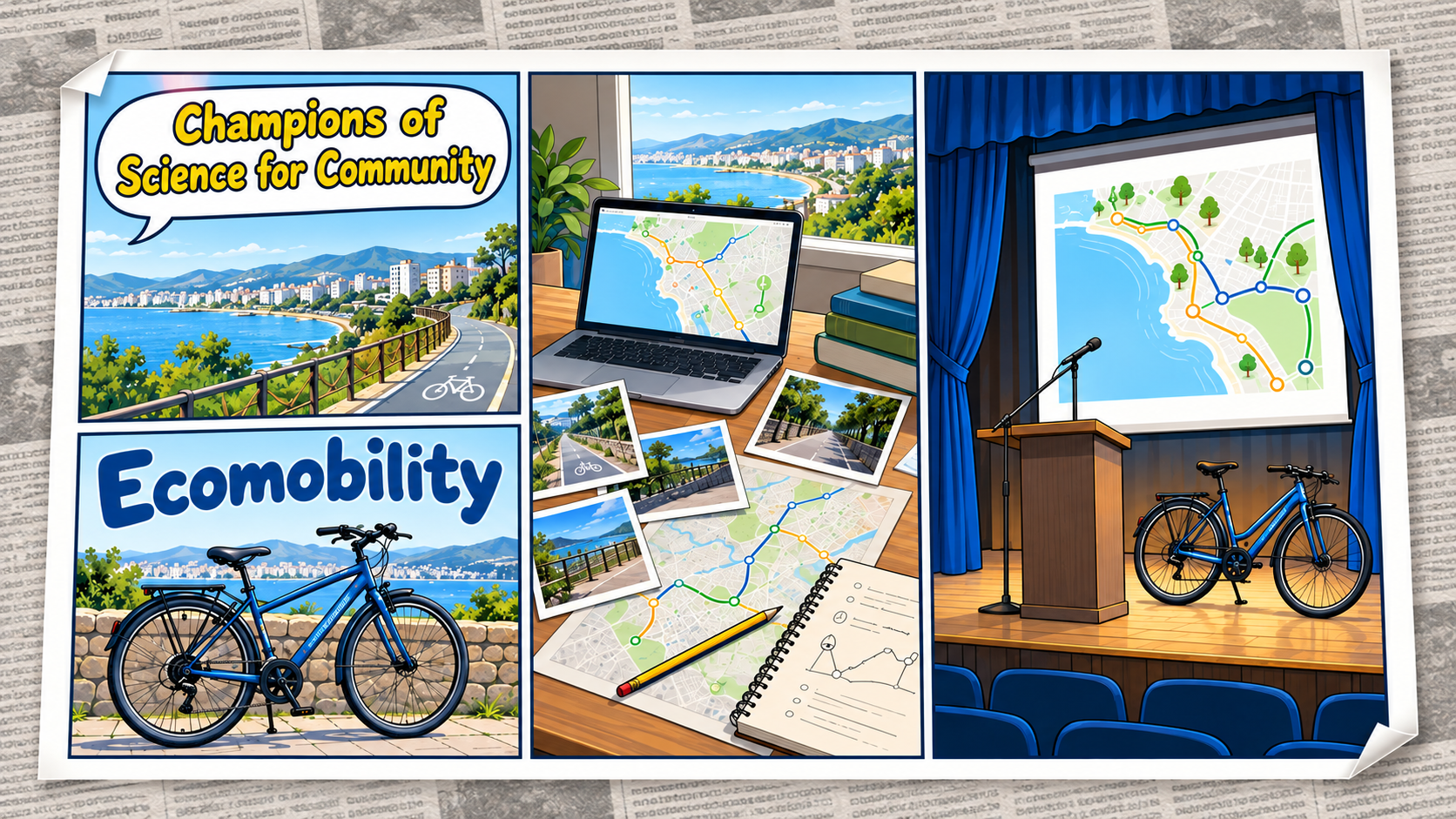
The cycling investigation began with a comparison. Students studied Utrecht in the Netherlands, examining how cycling worked there before turning their attention to Kalamata. They investigated a section of their own city’s bicycle route, photographing obstacles and problem areas. Their inquiry included interviews with a university professor from Utrecht, the deputy mayor responsible for climate change, and a person from Kalamata with experience living in Utrecht. They presented their research through the Ecomobility initiative’s EcoCity competition. School account, April 4, 2026
Those different sources gave the work substance. A photograph can make a problem visible. An interview can introduce a perspective that a photograph cannot capture. A comparison with another city can help students question whether familiar conditions are inevitable. Together, these approaches offer an educator several ways to move a conversation from preference toward evidence.
Georgia’s later account adds an important detail: the students created an interactive digital map showing their vision for a safer cycling route. Their proposals included improved signs, safety sensors, and smart helmets. They combined their findings with theatrical presentation, bringing artistic expression into the communication of their research.
The event also included a shared song performance with students from the school’s program for learners who are deaf or hard of hearing, accompanied by Greek Sign Language. Georgia reports that the school’s team earned second place nationally in the EcoCity competition. The map and presentation were completed products; the proposed street improvements should not be mistaken for infrastructure already installed. Georgia’s account, July 11, 2026
The variety matters. Research did not have to end as a report that only an educator would read. Students had something to show, something to explain, and several ways to communicate it.
Meet the educator
Georgia, known as Gina in Alison Wood’s published interview, is a science teacher at the 5th Gymnasium of Kalamata. She also serves as an eTwinning Ambassador, Scientix Ambassador, ITE eTwinning Ambassador, Local Facilitator and Mentor in the Climate Coalition’s mentoring scheme, and EU Code Week Leading Teacher. Her interest extends beyond helping students understand scientific ideas. She wants them to practice participating in the world around them.
In Wood’s interview, Georgia identifies supportive colleagues, professional development, and student motivation as sources of energy. Her description of colleagues is direct: “If you have good colleagues, everything is possible.” She also describes continuing to learn through professional networks, including eTwinning and Scientix. Alison Wood’s interview, April 23, 2026
Georgia credits her colleagues Andriana, Evelyn and Filitsa, alongside the students whose research, ideas and presentations made the projects possible. Their contributions are part of the shared work.
What went into it
The practical challenge will sound familiar to educators. Georgia told Wood that bringing interested students together for research during the regular timetable is difficult, so the group meets after school to study and plan. The work requires time, and she describes professional learning and relationships as part of what sustains it. Educator interview
Her students’ environmental investigations also reach beyond cycling. In a separate eTwinning project, learners measured temperatures across asphalt, soil, grass, shaded areas, and sunny locations around the school. They recorded and compared the results, then exchanged data, presentations, and digital stories with students in other countries through TwinSpace. The project connected schools in coastal and inland settings, giving students different conditions to compare. It concluded with a shared digital product and an awareness campaign addressing urban heat. Georgia’s urban-heat account, June 10, 2026
Here, a schoolyard becomes a place to investigate a scientific question. Why might one surface behave differently from another? What would make a comparison fair? What else could explain a difference? Those are useful questions for educators adapting this approach, with observations and measurements giving students something concrete to discuss.
The wider school community provides another example of the collaborative setting around this work. In a separate participatory-design activity, municipal collaborator Amerissa worked regularly with a class examining public spaces. Students considered the needs of children, older adults, people with disabilities, cyclists, and pedestrians. They used drawings, models, and presentations to propose improvements to a park and cycling route. This was shared work with its own collaborators, rather than an accomplishment to assign to Georgia alone. School account, July 11, 2026
Why it matters
There is something compelling about asking young people to contribute before they have all the answers. A recommendation requires them to make choices: which evidence matters, whose perspective is missing, and what they can reasonably claim. An educator can use those decisions to make student thinking visible throughout a project.
A September 11, 2026 study by North Carolina State University researchers offers a related research perspective. Using survey responses collected in 2021 from 1,854 U.S. residents, the researchers found that participation in citizen science was associated with stronger personal connections to science and greater perceived value of science. It was also associated with lower perceived credibility of science, making the findings more complicated than a simple success claim. The study establishes associations, not causation, and did not evaluate Georgia’s students. PLOS One study
For this story, its relevance is the attention it gives to people’s relationship with science: interest, confidence, identity, and belonging. Those dimensions invite educators to ask more than whether students finished a product. What did they become curious about? What can they explain now? Where did they recognize a role for themselves?
Georgia’s work gives those questions a concrete setting. A bicycle route, a temperature reading, or a public presentation can become a starting point for examining how knowledge is used.
Bring the idea to your classroom
Educators could adapt the approach by beginning with one place students know and one question they care about. A shaded waiting area, a walking route, or a shared school space may offer enough material for a manageable investigation. The educator can help learners decide what evidence they need and how to collect it safely, with meaningful alternatives for anyone unable to participate in outdoor observation.
Before choosing the final product, educators and students can identify an audience: people who could learn from the findings or understand the issue from another perspective. Students can connect each recommendation to evidence, acknowledge uncertainty, and explain what they would investigate next. A map, model, short performance, or presentation can serve that purpose when the format helps the audience understand.
The first project does not need to redesign a city. It needs a question worth pursuing and someone willing to listen.
A familiar place can become a new kind of classroom. Students can draw attention to details that others have stopped noticing.
Help Me Try This
Download Give Your Evidence an Audience, the two-page educator guide (PDF). Includes a practical classroom adaptation and three optional AI planning prompts.
By Scott Meech. Sources: Alison Wood’s April 23, 2026 interview; the school’s April 4 and July 11, 2026 project accounts; Georgia Mouselimi’s June 10 and July 11, 2026 Eco-Schools reports; and the September 11, 2026 PLOS One study linked above. Classroom adaptations and editorial takeaway are by Champions of Learning.
Champions of Learning · Story card
Champion of Science for Community
Georgia Mouselimi
Science teacher · 5th Gymnasium of Kalamata · Kalamata, Greece
Editorial takeaway
Educators can help students investigate the places they know, then give their evidence an audience.
Explore more educator stories.