
Listen to this story · 6 min · narrated with an AI voice
What they made happen
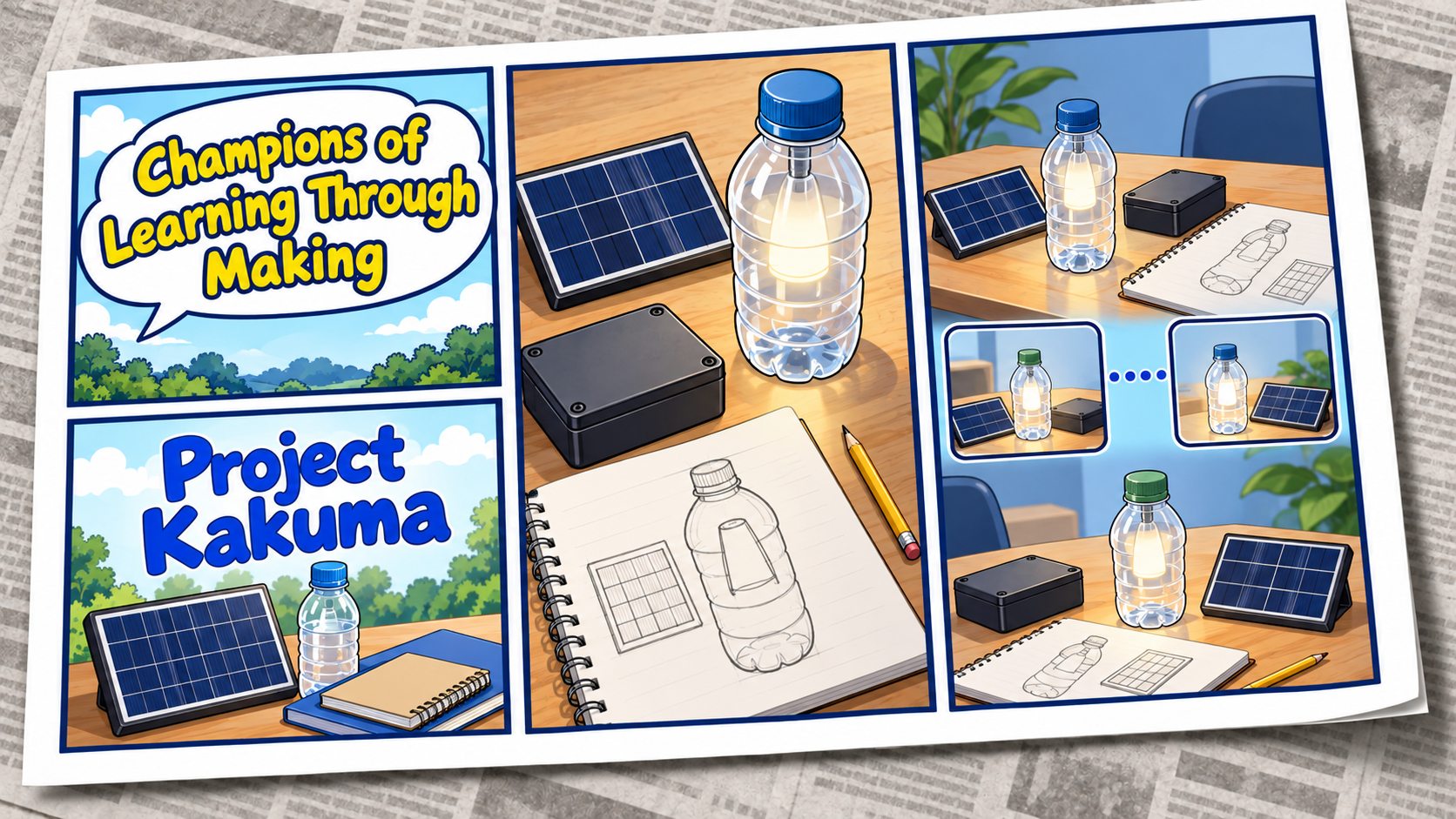
What happens when the light a student builds in class is the light they can take home that evening? That possibility drew me into Koen Timmers’s work at Kakuma Refugee Camp in Kenya. A plastic bottle, a small solar panel and a battery become something a learner can make, explain and use. In homes without electricity, the reason for understanding that circuit reaches well beyond the lesson. [1] [8]
During a workshop described in a July 2025 UNHCR story, nearly 60 students assembled solar lights in three hours. They soldered wires, connected components and put their finished lights outside to charge. The account, co-authored by Charity Nzomo and Koen, follows the work from the classroom into students’ homes. It is that journey that makes the project compelling: something built while learning could become useful that very night. [8]
The work continued beyond that workshop. By November 2025, Project Kakuma reported a total of 150 student-created lights. [2] Behind that number is the part of the story I want to stay with: learners taking a familiar need and gaining the tools to respond to it themselves.
Meet the educator
Koen’s connection with Kakuma began with a laptop. In 2015, the Belgian educator sent his own computer to the camp, arranged an internet connection and started teaching through Skype. [3] A decade before the solar-light exchange, he was already finding a way for teaching and learning to cross the distance between classrooms.
Today, Koen is co-founder and director of Take Action Global, whose projects include Project Kakuma. [9] Two learning spaces built in 2020 gave the work a physical home, complementing the teaching in neighbouring schools. [1] The solar lights grew within that wider collaboration, with local refugees and international partners contributing alongside Koen. [4] His part in the story is bringing people, resources and learning opportunities together so that students have something meaningful to work on, and people to work with.
What went into it
As the lights took shape, learners helped one another with the construction. [5] There were practical connections to make between panels, batteries and bulbs, but Koen’s project also made room for a connection between the people doing the building. Students in Belgium were making solar lights of their own, ready for an online exchange with their peers in Kakuma. [1]
When the two groups met online, their designs gave them an immediate way into conversation. The Belgian students had used cardboard boxes; the Kakuma students had used plastic bottles and added a working switch. They could show one another how they had approached the same task, then ask about each other’s lives. [8] A shared object made the distance between the classrooms a little easier to cross.
An exchange like that depends on preparation that a finished lamp cannot show. Project Kakuma’s wider teaching approach includes live video classes, teacher training and offline resources for use when connectivity is limited. [6] The materials and the means to communicate both matter. Together, they make it possible for a learner’s work to travel beyond the table where it was built.
Why it matters
What stays with me is how closely the making and the purpose belong together. A circuit becomes easier to care about when it powers something you want to use. A design becomes worth explaining when someone else has built a different version and wants to compare. Koen and his collaborators created an opportunity for those connections to happen; the learners brought their own building and explaining to it.
That is also where the teaching deserves attention. Helping students make something useful takes preparation, questions and time to return to what they are learning. A study led by Michigan State University offers a helpful connection: across 46 Michigan schools, third-graders in a project-based science programme scored higher on a science assessment than the comparison group and reported more reflection and collaboration. [7]
That programme included four science units, teaching materials, professional learning and assessments. It did not evaluate Project Kakuma or establish what one lamp-building activity achieves. [7] Its relevance here is the care around the task. The object can give learners a reason to investigate, while a teacher helps them explain what they have discovered.
Bring the idea to your classroom
You might begin with the question that makes these lights so compelling: what could our learners make that someone would have a reason to use? Invite students to talk with the people who would use it before settling on a design. If they choose a light, find out where it needs to stand, how someone will switch it on and what it needs to illuminate. Those answers give students something meaningful to test.
Then make room for the science and the revision. Choose age-appropriate, low-voltage materials with qualified supervision; soldering and rechargeable batteries need suitable expertise and controls. A preassembled educational kit may be the right starting point for your group. Students can still make decisions, explain the circuit and improve how their design meets a person’s needs.
Before the work leaves the classroom, invite learners to show someone what they changed and why. Talk about who will maintain it and what happens if a part fails. The invitation in Koen’s story is to follow learning all the way to its use. A student starts with components on a table and finishes with something they can carry into the world, along with an explanation of how it works.
Help Me Try This
Download the two-page teacher guide (PDF). A Champions of Learning adaptation inspired by this work, with three optional AI prompts.
Source credits
[1] Project Kakuma Annual Report 2025. Published 24 February 2026. Pages 3 and 26–28. Project context, solar-light construction and student exchange.
[2] Solar Light Project. Koen Timmers, Project Kakuma, 15 November 2025. Reported total and student exchange.
[3] Project Kakuma. Project account of its founding in 2015.
[4] Project Kakuma Brings Solar Innovation and Hope to Refugee Camp. Global Teacher Prize, 3 June 2025. Shared contributions to the solar bottle activity.
[5] Hope Through Solar Lights. Project Kakuma, undated first-person account by Timmers. Construction and exchange details.
[6] Our Schools. Project Kakuma. Teaching, collaboration and offline resources.
[7] Original project based science study. Krajcik, Schneider and colleagues. First online 2 November 2022; American Educational Research Journal 60(1), February 2023, pages 70–102.
[8] Illuminating Kakuma one solar light at a time. Charity Nzomo and Koen Timmers, UNHCR Kenya, 16 July 2025. Workshop and student exchange account.
[9] Take Action Global: Our Team. Current organizational role; Koen also clarified his co-founder role and Project Kakuma’s place within TAG in correspondence with Champions of Learning.
Further viewing: Heroes for the Planet, episode 3: Project Kakuma. Background on the school-building work, separate from the 2025 solar-light project.
Champions of Learning · Story card
Champion of learning through making
Koen Timmers
Co-founder and director · Take Action Global; founder · Project Kakuma
Editorial takeaway
Give learners a useful problem to investigate, then make room for them to build, explain and improve their response.
Explore more educator stories.