
Listen to this story · 7 min · narrated with an AI voice
What they made happen
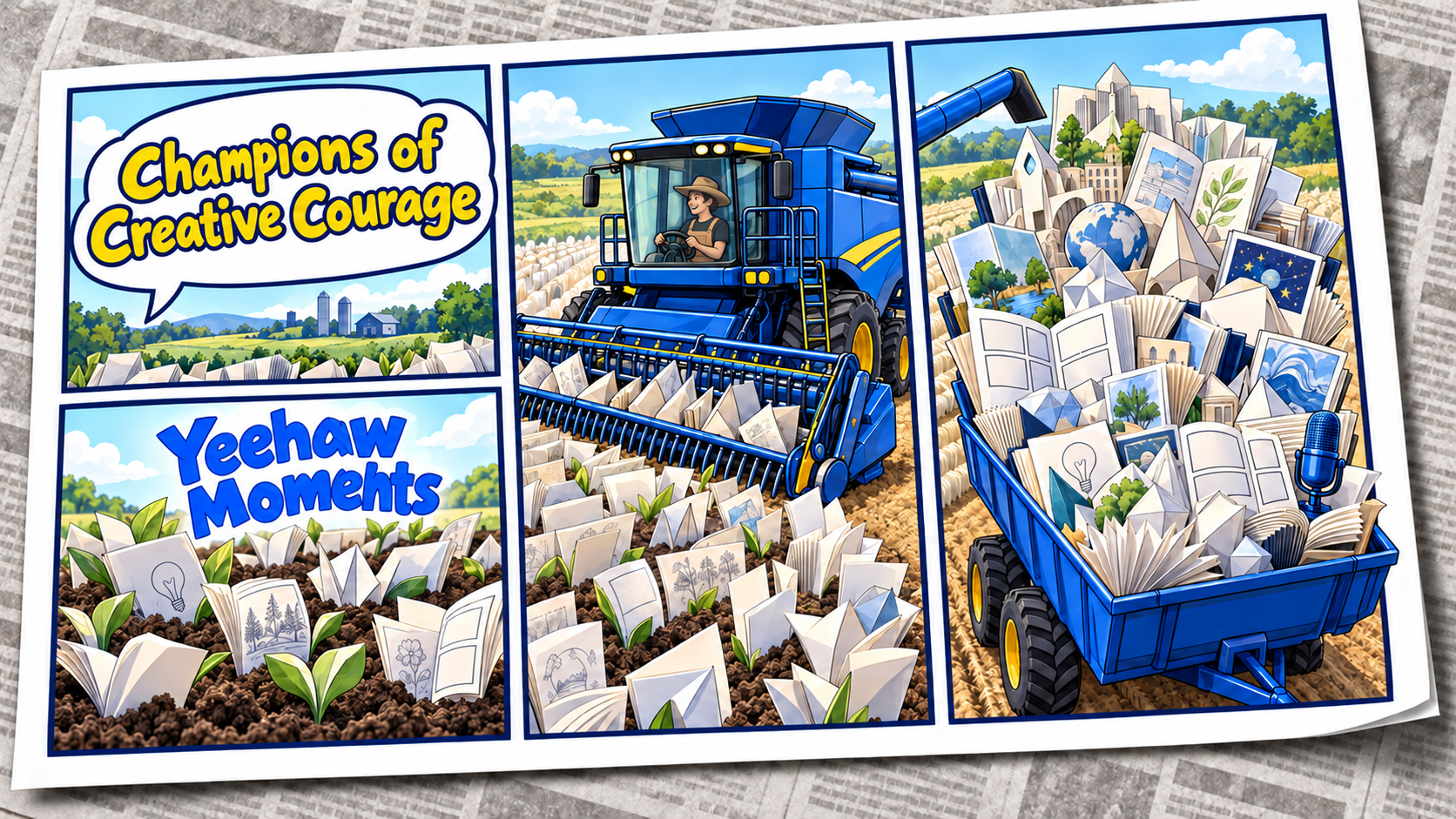
A superhero with a backstory. A trading card featuring a student’s own creation. A digital book ready to share with the school. Farmer Faubs, Alyssa Faubion, remembers sixth graders making their Junior EduGuardians projects, collaborating and proudly showing their work. She has a name for that kind of breakthrough: a “Yeehaw Moment.” Helping educators create the conditions for those moments is central to her work.
Faubion brings an enthusiasm that invites other educators to create. In The Bridge podcast’s “Courageous, Contagious, and Creative with Farmer Faubs,” host Cate Tolnai connects that spirit with giving others “permission to shine.” Faubion encourages teachers to share classroom ideas so colleagues can find inspiration and the confidence to try.
Her Yeehaw Moment Framework gives that invitation a structure. The Foundation focuses on time and clarity for teachers. The Spark makes room for student creativity. The Roar centers student voice and choice. Together, they connect professional learning with opportunities for students to make and share meaningful work.
Meet the educator
Before coaching, Faubion spent ten years teaching Digital Media. She traces her love of giving students opportunities to create to those classroom years. That commitment carried into instructional design coaching with Forward Edge and Bethel-Tate. In February 2025, Book Creator announced that she had joined its team to support schools piloting the platform, providing guidance, resources and content. Her current website presents her work as an EdTech keynote speaker and workshop facilitator.
She is also a co-founder of EduGuardians, alongside Heather Brown, Larisa Black, Christie Cloud and Aileen Wallace. Their community grew from professional connections and shared creative experimentation. That shared credit matters: the network brings together different educators’ strengths and gives them opportunities to learn from one another.
Faubion’s farm-inspired name and the “Yeehaw” invitation make her approach memorable. At its center is a recognizable educational ambition: a learner gaining confidence in an idea and finding a way to express it.
What went into it
The Foundation begins before students open a creation tool. Faubion places the teacher’s need for time and clarity at the base of her framework. She describes AI as a thought partner for designing stronger lessons, reducing planning demands and personalizing learning. The starting point is the work of making a worthwhile learning experience possible.
That is an important distinction for an educator facing an unfamiliar approach. A compelling example can open a possibility; a workable plan helps someone act on it. Goals, materials and decisions about support give the enthusiasm somewhere to go.
The Spark turns attention toward students. Faubion’s framework invites them to combine AI with their creativity, move beyond the blank page and develop work that matters to them. Their questions and decisions give the activity its direction. Technology becomes part of the creative process, while the learner has something to contribute.
The Roar asks what happens when that contribution reaches others. Students choose ways to communicate, using accessible tools and sharing with audiences beyond their classroom. The sequence moves from teacher preparation to student creation and then outward to a listener, reader or viewer.
The earlier Junior EduGuardians example makes that creative invitation tangible. Students made superhero identities, backstories and books, then shared their work with their school. Their creations offered different ways to represent themselves within a common project.
Why it matters
The excitement in this story belongs to the people doing the learning. For teachers, it can begin with seeing an idea that feels worth trying. For students, it can come from having a meaningful decision to make, a creation to develop and someone with whom to share it.
Faubion’s contribution brings those experiences into the same conversation. Professional learning starts a chain of choices: what a teacher makes possible, how a learner responds and where that work might go next. Her framework gives educators a way to consider each part.
Faubion makes the human experience of professional learning part of its purpose. In her conversation with Tolnai, she describes wanting educators to leave with laughter, a connection to someone else and confidence in their creativity. That encouragement gives teachers an inviting place to begin an experiment and people with whom to keep learning.
Bring the idea to your classroom
A practical adaptation inspired by Faubion’s framework begins with one learning goal and one audience. With a colleague, consider where students could make a meaningful choice about how they explain a concept. Use an approved AI tool as a planning thought partner if useful, then verify and revise its suggestions.
Invite students to bring their own questions and ideas. Offer a few accessible ways to create, with checkpoints for explaining decisions and revising the work. Where student AI use is appropriate and permitted, teach learners to evaluate assistance and describe how they used it.
Arrange a real audience, such as a partner class, families or a community collaborator, with the necessary consent and accessibility supports. Ask learners what they want that audience to understand. After sharing, return to the work: what became clearer, which choices helped and what deserves another attempt?
These are editorial adaptations for teachers to consider. Faubion’s own professional learning offers the opportunity to explore her framework more deeply. Her invitation remains a joyful one: create the conditions in which a student has something to say and discovers the confidence to share it.
Help Me Try This
Download the two-page Foundation, Spark, Roar teacher adaptation guide (PDF). Includes practical suggestions and three copy-ready AI prompts.
Sources
Farmer Faubs: Yeehaw Moment Framework. Undated educator-owned website, accessed October 29, 2026; supports her framework and professional-learning focus. Framework descriptions are her stated approach, not measured outcomes.
David Hotler, “Ambassador Spotlight: Farmer Faubs,” September 27, 2024. Historical vendor-hosted educator account supporting the coaching role and Junior EduGuardians example.
Dan Kemp, “New team members at Book Creator,” February 21, 2025. Company announcement supporting her role at that time. EduGuardians: About Us, undated organizational account, supports community origins and collaborators.
Cate Tolnai, The Bridge, Episode 14: “Courageous, Contagious, and Creative with Farmer Faubs,” Alludo, November 16, 2025. Published interview transcript supporting educator motivation, community and Faubion’s professional-learning approach. The phrase “permission to shine” is Tolnai’s connection to a saying, not a measured result.
Champions of Learning · Story card
Champion of Creative Courage
Farmer Faubs
Alyssa Faubion · EdTech speaker and workshop facilitator · EduGuardians co-founder · United States
Editorial takeaway
Give educators the confidence to begin, and students the freedom to create.
Explore more educator stories.