
Listen to this story · 6 min · narrated with an AI voice
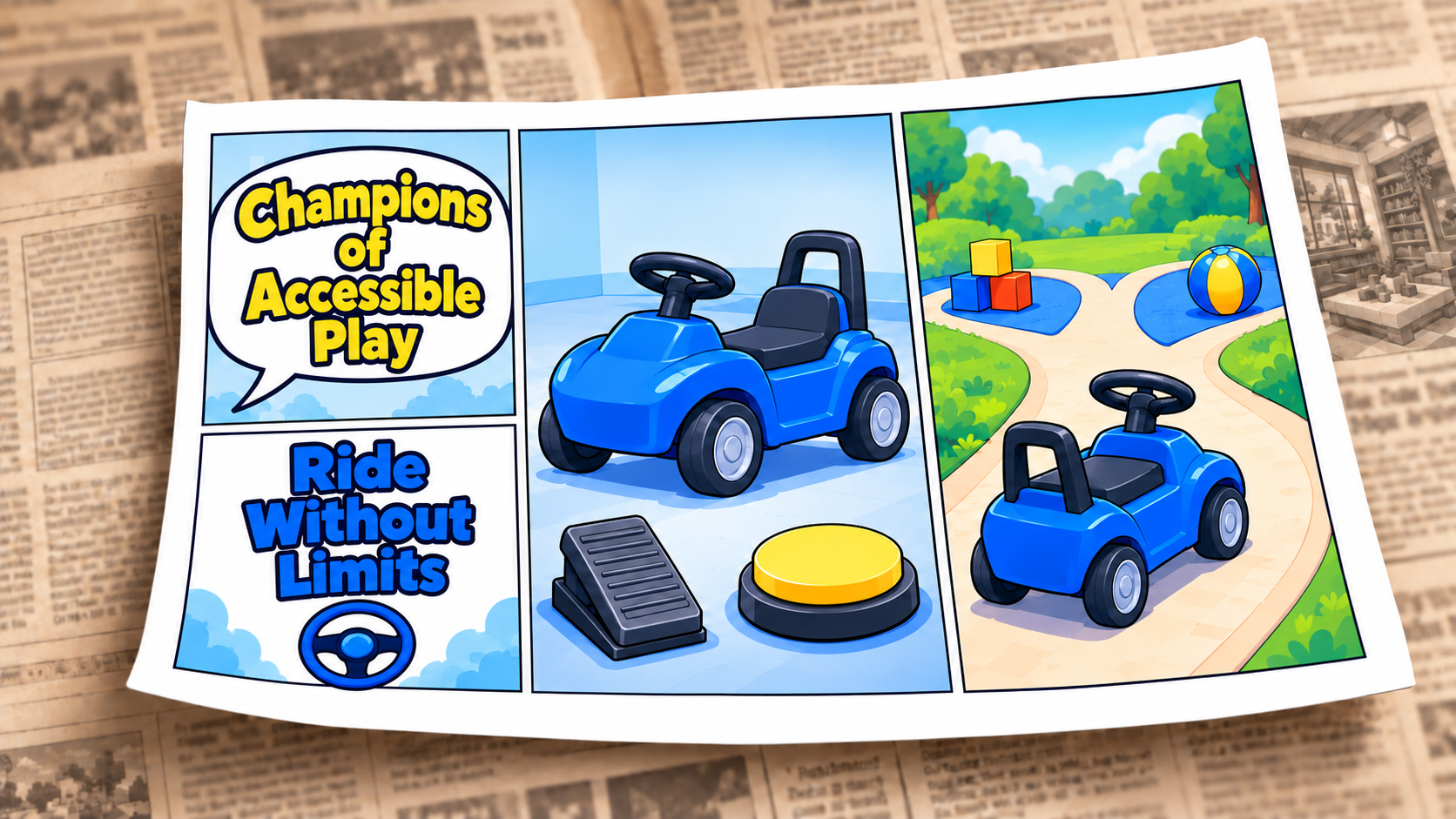
Conceptual illustration inspired by Ride Without Limits; not a replica of the vehicle or its controls.
For most kids, a toy ride-on car starts with a press of the foot pedal. For some, that pedal is the reason they can’t drive at all. At Dove Virtual Academy in Oklahoma, Sara Mehrabi asked her students to start somewhere else: with the child behind the wheel. Instead of asking how the car works, they asked who it needed to work for, and then rebuilt the vehicle around that child. [1]
What they made happen
Through Ride Without Limits, part of Dove Virtual Academy’s Go Baby Go work, students adapted a battery-powered toy car for a child who could not operate its original controls. The project was shared through the Ciena Solutions Challenge. [1] Sara’s account of a January 29, 2026 school event describes a vehicle that had already been delivered. She credits students with rewiring it, adding a hand-activated steering control and programming a remote-operation system. [2] Those details make the project concrete: students worked on how a person would command the vehicle, rather than stopping at a model or presentation.
In her September 30 retrospective for Digital Promise, Sara reports delivering the car at Oklahoma Children’s Hospital and seeing the child drive independently. [1] It is an account of that moment, not a long-term evaluation.
Meet the educator
Sara is an Academic and Outreach Programs Coordinator and math teacher at Dove Virtual Academy. [1] The school places STEM and character education alongside one another in its stated educational focus. [3] That setting gives this project a recognizable home: technical learning connected with responsibility toward other people.
Her teaching also reaches college students. In May 2026, Rose State College named Sara, an adjunct professor in STEM, among its Excellence in Teaching Award recipients for adjunct faculty. [4] That recognition is a separate part of her teaching background, rather than an award for this vehicle.
What went into it
Sara describes several weeks of research, brainstorming and prototype testing. Students modified electrical systems and controls, and returned to ideas that needed redesigning. She noticed their questions moving toward whether the child would be able to use the car. Her contribution was to keep that intended user in view while the technical work developed. [1]
This story sits within a wider school effort. An August 12, 2025 Oklahoma State Department of Education newsletter describes Dove Virtual Academy’s middle and high school computer science and engineering clubs working on Go Baby Go vehicles. It credits computer science teachers Mr. Mammadov and Ms. John and names Bethany Children’s Health Center as a partner. Its account includes component selection, programming, circuitry and repeated testing. [5] Those credits describe the school’s broader program; Sara’s account centers on the car delivered at Oklahoma Children’s Hospital. [1]
Why it matters
The useful educational distinction is between getting a device to work and considering who can use it. A control can function exactly as designed while remaining inaccessible to its intended user. That is a practical question for a design classroom, not a claim that this project measured gains in students’ learning.
Related research offers a carefully bounded view of why access to play can matter. Jennifer M. Yates of Missouri State University and Martin S. Rice of Texas Woman’s University examined caregivers’ perspectives in Parental Perspectives on the Impact of Adapted Motorized Ride-on Toy Vehicle Use for Children with Limited Mobility: A Multiple Case Study, first published online on January 2, 2026. The researchers used interviews and field notes involving caregivers of three children, four to six months after the children received adapted vehicles. Parents described greater independence, participation and emotional growth. [6]
This small qualitative study concerns parent-reported experiences. It does not establish a causal effect, measure student learning or evaluate Sara’s project. [6] Read alongside her account, it offers a reason to pay attention to what a child can choose and do during play, while leaving the longer-term outcome of this particular car open.
Bring the idea to your classroom
The following is an editorial classroom adaptation, not a verified description of Sara’s teaching method. Start with a low-risk everyday object or classroom routine, such as a storage label or a way to request materials. Ask learners who uses it, what gets in the way and what a more usable version would allow someone to do. Invite feedback without asking anyone to disclose a disability or medical information.
Choose one observable goal before building. A label redesign, for example, might help a classmate locate the right materials without an explanation. Have students sketch alternatives, make a simple prototype and invite a willing user to try it. Keep a brief record of what happened and what changed. Ask students to explain the reason for a revision, including cases where their first assumption was wrong.
A modified ride-on vehicle is a different undertaking from a paper prototype. Treat it as a specialist partnership, with qualified adults responsible for individual suitability, engineering checks and safe use, rather than as a classroom build recipe. A class can explore the design question without putting a child into an unverified device. End the learning sequence by examining whose feedback shaped the result and what still needs to be understood.
Help Me Try This
Download the Design a Better Classroom Routine teacher guide (PDF)
Sources and credits
- Sara Mehrabi, Digital Promise, September 30, 2026. Retrospective and Ride Without Limits project link.
- Sara Mehrabi, LinkedIn. Account of the January 29, 2026 school event and completed delivery.
- Dove Virtual Academy. School educational focus.
- Rose State College, May 14, 2026. Excellence Awards announcement.
- Oklahoma State Department of Education, August 12, 2025. Earlier school Go Baby Go program context.
- Yates and Rice, Occupational Therapy in Health Care, January 2, 2026. Research publication. Also available through Missouri State University repository. Research abstract and author affiliations. and PubMed, PMID 41481103. Online-first publication date and research abstract.
Champions of Learning · Story card
Common Value: Belonging
Sara Mehrabi
Academic and Outreach Programs Coordinator and Math Teacher | Dove Virtual Academy
Editorial takeaway
Define success by what the intended user can do, then give students room to revise.
Oklahoma, United States
Explore more educator stories.