
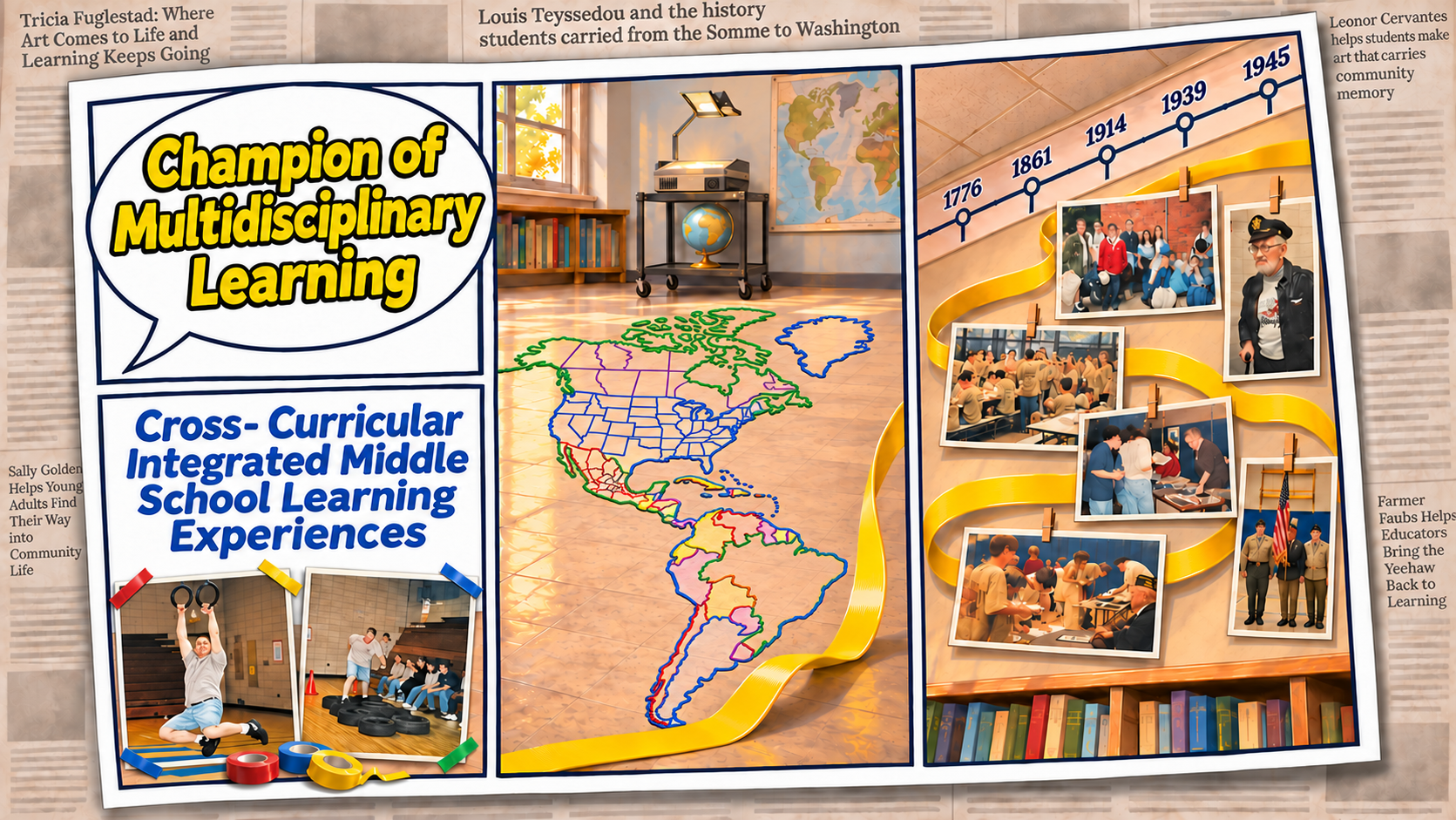
Activo, auténtico, moderno y creativo: el enfoque de Scott Meech sobre el aprendizaje
Traducción automática del inglés. No ha sido revisada por el educador. El audio y la guía en PDF están disponibles en inglés.
Lo que hicieron posible
«Ojalá pudiera volver y hablar con el docente que era en 1995. He aprendido muchísimo desde entonces y, al mismo tiempo, estoy más convencido que nunca de que las experiencias de aprendizaje deben ser activas, auténticas, modernas y creativas». – Scott Meech
Si entrabas en su aula en aquellos primeros años, una de las primeras cosas que notarías era un gran mapa que se extendía por el suelo, creado por los estudiantes con cinta eléctrica de colores. Lo construyeron utilizando una cuadrícula proyectada y sus conocimientos de latitud y longitud. Un conserje que apoyaba el proyecto incluso enceró sobre la cinta para que el mapa pudiera permanecer durante todo el año escolar.
El mapa siguió cambiando a medida que los estudiantes aprendían. Durante las discusiones, se situaban en distintos lugares, colocándose dentro de la geografía que estudiaban. Al mirar hacia arriba, veían una línea de tiempo que se extendía por las paredes cerca del techo, llena de acontecimientos que habían ayudado a seleccionar. En esta aula, la historia no se limitaba a un libro de texto. Tenía una presencia física que los estudiantes ayudaron a construir. [1]
Scott solía convencer a sus colegas de participar en ideas que algunos describirían como poco convencionales y otros llamarían simplemente locuras.
La jornada nocturna sobre la Segunda Guerra Mundial en Gurrie llevó ese espíritu más allá de una clase habitual. También reflejaba una convicción de su enseñanza: los estudiantes necesitaban contexto para conectar con vidas y acontecimientos alejados de su experiencia. [4]
Incluso su madre participó. A petición de Scott, compartió historias sobre el servicio militar de su padre y su infancia en la Alemania de posguerra, incorporando la memoria familiar al estudio del período. [4]

Immigration Day extendía ese enfoque a toda la jornada escolar. Los estudiantes investigaban a una persona real utilizando registros de Ellis Island y se vestían para representar su papel. Al llegar a la escuela, comenzaban un viaje transatlántico simulado en el sótano, sentados en un espacio que representaba el alojamiento de tercera clase de un barco. Los sonidos de tormentas, una lectura en voz alta y la conversación les invitaban a considerar cómo podría haber sido la travesía. Después pasaban al gimnasio, que representaba Ellis Island, con padres y madres a cargo de las estaciones. El almuerzo en la cafetería se convertía en una fila para recibir sopa y pan. Las actividades de todas las asignaturas se conectaban con el tema de la inmigración, reuniendo a colegas y familias en una experiencia compartida. Eran representaciones educativas de experiencias históricas, un contexto para investigar y no una reproducción de lo vivido por los inmigrantes. [4]
La excursión de octavo grado a Washington, DC, ofreció otra conexión con un lugar fuera de la escuela. Scott acompañó a los estudiantes a la capital; las fotografías de su archivo muestran al grupo frente a la Casa Blanca y una vigilia por la paz cercana. Las imágenes documentan la visita, sin establecer qué aprendió cada estudiante. [4]

Estas experiencias reflejaban la convicción de Scott de integrar profundamente el aprendizaje activo en los estudios sociales. Las estaciones, los juegos de roles y las oportunidades fuera del aula ofrecían distintas formas de participar. Quería que los estudiantes vivieran los estudios sociales, en lugar de limitarse a aprender sobre ellos: investigar, tomar decisiones, adoptar perspectivas y conectar su aprendizaje con personas y lugares. [4]
Esa disposición a participar también incluía al propio Scott. Además de utilizar un retroproyector, que recuerda como una herramienta moderna de enseñanza en su aula de aquella época, se vestía como una figura histórica. Una fotografía lo muestra como Theodore Roosevelt junto a estudiantes. La herramienta y el disfraz eran distintas formas de abrir una lección, parte de su esfuerzo por hacer que la materia resultara accesible y digna de explorar. [4]

Para Scott Meech, estas eran maneras de conectar con un aprendizaje más profundo. El reto mayor consistía en hacer que las experiencias se apoyaran unas en otras. Un mapa, un juego o una simulación necesitaban un lugar en el aprendizaje anterior y posterior.
Los estudiantes ayudaban a dar una forma visible a esa continuidad. Seleccionaban imágenes, decidían qué acontecimientos importaban, interpretaban documentos y creaban materiales para sus compañeros. Su trabajo contribuía al aula, en lugar de desaparecer al terminar una tarea. [1]
Lo que hubo detrás
Una vez que el mapa estuvo en el suelo, Scott tenía un recurso al que volver mientras avanzaba el curso. Los estudiantes ya habían usado una cuadrícula proyectada y sus conocimientos de ubicación para construirlo; ahora ese mismo espacio podía apoyar otra discusión. La línea de tiempo que crecía alrededor del aula ofrecía una segunda manera de llevar el trabajo anterior a una nueva unidad. Los estudiantes elegían personas y acontecimientos y reconsideraban su importancia al aprender más. Al terminar el curso evaluaban la relevancia de lo que habían incluido. La lectura, la escritura y el juicio histórico formaban parte de una conversación continua, con sus propias decisiones todavía visibles a su alrededor. [1]
Los juegos de cartas se desarrollaban junto a ese trabajo. A lo largo de las unidades, los estudiantes utilizaban Microsoft Word para crear cartas de acontecimientos históricos y elegir imágenes. A medida que reunían mazos considerables, tenían más material con el que jugar y pensar. Un cambio de reglas podía exigir reconsiderar las relaciones entre acontecimientos ya estudiados. Después, las cartas podían volver a la discusión de la línea de tiempo o servir para escribir reflexiones. Una decisión de diseño de un estudiante se convertía en algo que utilizaría un compañero; una carta terminada podía seguir contribuyendo al curso en lugar de señalar el final de una tarea. [1]
Al avanzar por distintos períodos históricos, Scott también cambiaba las formas de comunicación. Durante el estudio de la Revolución, algunos estudiantes compartían panfletos. Cerca de la Guerra Civil, simulaban mensajes telegráficos con código Morse; durante la Primera Guerra Mundial, palomas mensajeras de imitación llevaban sus notas. [1] Y sí, incluso incorporaba juegos con bolas de papel parecidos al balón prisionero en las unidades sobre la guerra. Las reglas cambiaban según la época, como una forma lúdica de explorar cómo la tecnología disponible podía cambiar las condiciones de un conflicto. En la actividad sobre la Guerra Civil, los estudiantes se enfrentaban en filas y lanzaban con su mano más fuerte; en la versión de la Primera Guerra Mundial, actuaban con las limitaciones de una trinchera simulada.
Scott recuerda que eran actividades disparatadas y divertidas, y que los estudiantes conservaban mucho después el recuerdo de aquel contraste. Los juegos les daban una experiencia compartida que conectar con el estudio de los distintos períodos. [4] Estas actividades convivían con centros de indagación histórica que incluían experimentos, modelos y trabajo interactivo. Los estudiantes examinaban fuentes primarias mediante un enfoque que Scott asociaba al método científico y desarrollaban una guía de vocabulario durante el año. Con distintos materiales y formas de participar, buscaba hacer de la investigación algo recurrente. [1]
Llevar ese enfoque a experiencias más amplias requería a otras personas. El conserje que enceró el mapa ayudó a conservarlo durante el año. Las familias supervisaron las estaciones cuando el gimnasio se convirtió en Ellis Island, y la madre de Scott aportó historia familiar al evento nocturno sobre la Segunda Guerra Mundial. Sus contribuciones eran distintas, pero cada una hacía posible algo que Scott no podía ofrecer solo. La experiencia de los estudiantes era obra de colegas, familias y personal escolar, además de su docente. Scott dice que los colegas que lo ayudaron a lo largo de los años son demasiados para nombrarlos aquí. Rodearse de personas a las que admiraba le ayudó a dar lo mejor de sí y aprender de sus errores. Ese apoyo formaba parte de su crecimiento como docente. [4]

Cuando Scott comenzó a crear experiencias de aprendizaje con otros educadores, mantuvo el mismo interés por la participación y la disposición a reconsiderar el diseño. El 7 de noviembre de 2009 ayudó a un equipo local de facilitadores tecnológicos a organizar Collabocon, un encuentro gratuito y voluntario para las escuelas de New Trier Township. En su reflexión publicada, la respuesta positiva era alentadora, pero dejaba una pregunta: ¿cuánta colaboración adicional se produciría después? Quería acortar las presentaciones y dar más tiempo a la experimentación conjunta. Al recordar la planificación, atribuía lo conseguido a la comunicación clara, la confianza y el propósito compartido, no solo a la tecnología. [7]
Una pregunta relacionada lo llevó a fundar I Education Apps Review, o IEAR: ¿qué hacía educativa a una aplicación más allá de la etiqueta de su tienda? Revisar aplicaciones se convirtió en un motivo para reunir a educadores, revisores voluntarios y desarrolladores. Según Scott, algunos desarrolladores mejoraron sus aplicaciones tras recibir comentarios, y la iniciativa creció como una comunidad cuyos miembros asumían el trabajo como propio. Eran resultados comunicados por él, no hallazgos de una evaluación independiente. Scott indica que IEAR cerró cuando se incorporó a Apple. Fue una etapa de su esfuerzo por juzgar la tecnología según lo que pudiera hacer posible para aprender, en lugar de su novedad. [8, 4]
En District 58, donde Scott fue director de tecnología, esa pregunta formó parte de un esfuerzo más amplio con docentes, estudiantes, colegas y familias. El informe anual de 2013 describe Learning Labs en distintas escuelas y grados, apoyo para los profesores y talleres para familias desarrollados con la biblioteca pública. Los relatos de aula concretan el propósito: los estudiantes elegían herramientas para explicar su comprensión y los docentes describían cómo revisaban sus trabajos al ver ejemplos de sus compañeros. El informe presenta la experiencia del distrito, no una evaluación independiente ni un resultado atribuible a Scott solo. Aun así, registra un hilo conocido en su trabajo: crear condiciones para que los estudiantes hagan algo, lo compartan y vuelvan a ello con otra idea. [9]
Conozca al educador
Las preguntas detrás de ese trabajo comenzaron mucho antes, en la propia experiencia de Scott como estudiante y profesor principiante.
El trabajo de Scott en estudios sociales y artes del lenguaje en Gurrie Middle School, en La Grange, Illinois, sentó una base para funciones posteriores en enseñanza secundaria, tecnología educativa, liderazgo escolar y aprendizaje profesional. [4]
En una reflexión publicada, Scott explicó que su interés por enseñar historia surgió de sus preguntas y temas debatibles. Su experiencia escolar lo llevó a pensar en la diferencia entre completar una tarea y tener una razón para interesarse por ella. La relevancia y el desafío importaban en las experiencias que quería crear. [2]
Scott intentaba mejorar su enseñanza cada año, aprendiendo tanto de las experiencias que diseñaba como de las ideas que las inspiraban. En 1996, cuando enseñaba historia mundial en Roanoke High School, pidió a los estudiantes que inventaran culturas y crearan artefactos de apariencia realista que ofrecieran pistas sobre esas sociedades. Enterraron los objetos fuera de la escuela y las dos clases intercambiaron las zonas de excavación. Cada una se convirtió en un equipo de arqueólogos que desenterraba e interpretaba los artefactos de la otra. Los estudiantes compartían cómo creían que había sido aquella sociedad, construyendo un relato a partir de la evidencia encontrada.
Era otra manera de convertir los estudios sociales en una experiencia. También dejó a Scott una lección práctica para el siguiente intento: las mosquiteras de las ventanas de casa no sustituían bien a unos tamices resistentes. Cuando se rompieron, reemplazarlas resultó una parte inesperadamente costosa de la lección. [4]
También reconoció una debilidad en su planificación inicial. Podía dedicar mucho esfuerzo a lecciones individuales sin conectarlas en una progresión coherente. Una actividad podía funcionar por sí sola y dejar a los estudiantes sin un puente claro hacia la siguiente. [1]
Ese reconocimiento cambió el proceso de planificación. Además de buscar una lección atractiva, necesitaba considerar en qué deberían mejorar los estudiantes a lo largo de todo el año escolar. Una experiencia introducida en una unidad podía servir de recurso en otra y preparar un trabajo que reuniera aprendizajes de varios días.
El mapa y la línea de tiempo ofrecían respuestas prácticas. Permanecían en el aula, disponibles para volver a utilizarlos.
La enseñanza en el extranjero profundizó esa atención al contexto. Scott pasó cuatro años enseñando fuera de su país: dos en Corea del Sur y dos en Honduras. Considera que esos años fueron importantes para su desarrollo docente porque lo llevaron a comprender las culturas de sus estudiantes. El vocabulario, el idioma, el lenguaje corporal, las referencias compartidas y la manera de interpretar una tarea pueden influir en el encuentro en el aula. Para él, diseñar lecciones pertinentes y valiosas significaba aprender de las perspectivas y experiencias de los estudiantes, sin suponer que su propia manera de comunicarse tendría el mismo significado para todos. [4]

Entre los recuerdos favoritos de Scott de su enseñanza en Corea del Sur está ayudar a los estudiantes a viajar a un evento de Modelo de Naciones Unidas. Era su entrenador, aunque reconoce que su preparación fue mediocre. Una estudiante recibió un trato duro de un participante mayor y más experimentado. Aquello podría haberla desanimado a volver.
Sin embargo, Scott recuerda que regresó entusiasmada por el año siguiente, decidida a prepararse mejor y superarlo. Para él, su respuesta ilustraba lo que podía ocurrir cuando los estudiantes participaban activamente y sentían que la experiencia les pertenecía: una dificultad podía convertirse en un motivo para prepararse, perseverar e intentarlo de nuevo. También le hizo reflexionar sobre su responsabilidad de preparar a los estudiantes para las oportunidades que ayudaba a crear. [4]
Por qué importa
El mapa permanecía en el suelo después de terminar la lección. Los estudiantes podían volver a situarse sobre él, plantear otra pregunta y conectar un acontecimiento nuevo con un lugar conocido. Sus juegos de cartas tenían una vida parecida: la investigación y el diseño de un estudiante se convertían en algo que un compañero podía jugar, cuestionar o utilizar en una discusión posterior. Muchas veces, la audiencia estaba en la misma aula. Lo que creaban influía en lo que otros encontrarían, dando al trabajo un propósito más allá de entregarlo al profesor. [1]
Ese uso continuado ayuda a comprender lo que Scott intentaba construir mediante excursiones, roles y proyectos compartidos. Una experiencia podía abrir la puerta a la materia, pero los estudiantes necesitaban conocimientos para comprenderla. Leer, comparar evidencias y explicar una decisión daban sustancia a la actividad. La geografía ayudaba a entender un lugar; las artes del lenguaje, a interpretar y argumentar; el diseño, a hacer utilizable una idea. Las materias se unían porque los estudiantes las necesitaban para hacer algo significativo dentro de la experiencia.
El trabajo de otros educadores permite considerar esa conexión. En University of Illinois Urbana-Champaign, el curso de roles históricos de Leslie Reagan combina participación, fuentes primarias y discusión de lo que realmente ocurrió. En otro contexto, Bolaji Bamidele y Kristin A. Searle, de Utah State University, estudiaron una unidad de sexto grado en la que los estudiantes investigaban el acceso a alimentos, creaban mapas electrónicos y desarrollaban planes de acción. Identificaron funciones de expertos, investigadores y defensores. Ninguno de esos trabajos evalúa la enseñanza de Scott, pero ambos centran la atención en el pensamiento que puede acompañar la participación. El proyecto curricular de Jessica Blauwkamp en Grand Valley State University ofrece herramientas que enfatizan autenticidad, elección de los estudiantes y colaboración. [6, 3, 5]
La propia experiencia de Scott le impedía considerar un producto terminado como el final del aprendizaje. Había observado que un documento, video o pódcast impresionante no significaba necesariamente que los estudiantes hubieran desarrollado hábitos de aprendizaje tecnológico que pudieran llevar a la siguiente tarea. Eso lo devolvía a un problema de planificación que ya había reconocido: ¿cómo podían volver a una habilidad, fortalecerla y utilizarla con mayor independencia durante el año? El mapa y las colecciones de cartas ofrecían una respuesta. Una herramienta o proyecto cobraba utilidad al formar parte de una experiencia continua. [1]
Al adentrarse en la tecnología educativa, la pregunta sobre lo que los estudiantes podían crear lo acompañó. Su presentación de 2011 en K12 Online Conference, iCreate vs. iConsumption, exploraba usos creativos del iPad. En 2013, Beth Holland reconoció en Edutopia su adaptación del gráfico SAMR y su énfasis en hacer visible el pensamiento mediante grabaciones de pantalla. Los ejemplos de aula eran de otros educadores, pero la perspectiva atribuida a Scott centraba la atención en lo que los estudiantes podían expresar con una herramienta. Ese hilo continuaría en su trabajo con Apple. [10, 11]
Al recordar ese trabajo, Scott encuentra su mayor satisfacción en ayudar a las personas a ver la tecnología desde las posibilidades de crear, hacer, construir y desarrollar. Un retroproyector y un iPad pertenecían a momentos distintos de su carrera, pero ambos planteaban qué podía hacer alguien con ellos. Quería que los estudiantes fueran más allá de consumir lo que otros habían producido y descubrieran maneras de crear algo propio. [4]

Esa convicción incluye preocupaciones que no quiere ignorar. Para Scott, la posibilidad de amplificar la creatividad convive con inquietudes sobre usos perjudiciales de las redes sociales, depender de la IA para pensar, el consumo prolongado de pantallas y el impacto ambiental de la tecnología. Quiere que las personas consideren esas cuestiones al decidir. Su respuesta es ayudar a encontrar formas conscientes de utilizar la tecnología para el bien.
Champions of Learning nació de esa misma intención. Scott lo describe como una manera de compartir historias de educadores para que otros vean posibilidades para sus propios estudiantes. Las personas permanecen en el centro: su criterio, las experiencias que crean y las relaciones que hacen posible el trabajo. La tecnología sirve a ese propósito, igual que las herramientas del aula servían al aprendizaje que quería que sus estudiantes experimentaran. [4]
El mapa del suelo es una expresión temprana de la idea a la que vuelve: dar a los estudiantes algo significativo que hacer y espacio para retomarlo y mejorarlo. Ayudaban a construir un lugar para aprender, lo utilizaban juntos y podían volver con más conocimientos. A través de cambios de funciones y herramientas, esa invitación a participar activamente es lo que Scott ha seguido intentando ofrecer.
Lleve la idea a su aula
Comience identificando la comprensión que debería sostener una unidad integrada. Una pregunta como “¿Cómo cambia la comunicación quién puede participar?” podría conectar la indagación histórica, la lectura, la escritura y el diseño. Cada materia debería aportar algo que los estudiantes necesiten para responder bien a la pregunta.
Luego identifique la experiencia culminante. Los estudiantes podrían crear una exposición interactiva, diseñar un juego para otra clase o presentar una interpretación basada en evidencia mediante un medio que ayuden a elegir. La experiencia debería exigirles usar lo que han aprendido, dejando espacio para decisiones significativas sobre el contenido, el enfoque o la comunicación.
Planifique hacia atrás a partir de ese propósito. Si los estudiantes van a interpretar una fuente primaria para una audiencia, deles oportunidades repetidas de examinar fuentes y distinguir la evidencia de la inferencia. Si van a crear un juego histórico, permítales comprobar si sus reglas representan las relaciones que intentan explicar. Si van a participar en una simulación, establezca los conocimientos y la reflexión que les ayudarán a reconocer tanto su utilidad como sus límites.
Las estaciones pueden apoyar esa preparación cuando cada una tiene una contribución clara a la indagación compartida. Una podría implicar una lectura atenta, otra un mapa o un modelo, y otra una comparación de explicaciones que compiten entre sí. Los estudiantes podrían registrar cómo cada estación cambia o complica su respuesta a la pregunta central. El propósito es construir la comprensión a lo largo de las actividades.
Ofrezca a los estudiantes opciones que conlleven responsabilidad. Podrían elegir qué acontecimiento merece ser incluido, qué evidencia respalda mejor su interpretación o cómo explicar una idea difícil a estudiantes más jóvenes. Mantenga claras las expectativas de aprendizaje y permita distintos caminos para demostrarlas.
Haga que la experiencia final sea interactiva de maneras que sirvan al aprendizaje. Una audiencia podría probar un juego, hacer preguntas sobre una exposición o cuestionar una interpretación. Los estudiantes deberían tener la oportunidad de responder, reconsiderar y explicar, en lugar de limitarse a estar junto a un producto terminado.
Por último, vuelva al trabajo después del evento. Pregunte a los estudiantes qué decisión cambiarían, qué evidencia resultó más importante y qué comprenden ahora que no comprendían al principio. Sus respuestas pueden convertirse en un puente hacia la siguiente unidad.
Construya un aprendizaje que los estudiantes puedan llevar consigo y luego deles opciones significativas sobre lo que crean con él.
Stage report
- Stage just finished: Spanish translation of the educator story, delivered in the requested format. Incomplete or unverified: the translation has not been reviewed by the educator or a native-speaking editor. The story body contains no text links, only numbered source markers such as [1], which were kept as written. I did not independently verify the source dates (including the February 2, 2026 and August 5, 2026 dates) and translated them as given. The source brief for [4] has no formal title, so the credits describe it in Spanish.
- Approval needed: Scott, please approve this Spanish translation for publication, or send revisions to wording, register (usted versus tú), or the translated headings. I cannot publish it myself.
- Next stage: None until you direct it. Once you approve or request changes, the next step would be a revised translation or whichever stage you name.
Descargue la guía para docentes (PDF, en inglés)
Historia de Scott Meech. Fuentes: “Scaffolding your Lesson Plans: Lessons Learned from Traditional Teaching!”; “Why do I love to present, talk and write about education?”; “Critical Student Agency in an Integrated Social Studies Unit”; informe de investigación y dirección editorial proporcionados por el educador; “Cross-Curricular Project-Based Learning as an Answer to Disengagement in Middle School Students”; “Inside HIST 203: Reacting to the Past” (University of Illinois Urbana-Champaign, 21 de octubre de 2024).
능동적이고 실제적이며 현대적이고 창의적인 학습: 스콧 미치의 교육 방식
영어 원문을 AI로 번역했습니다. 한국어 능통자의 검토를 받지 않았습니다. 사진 속 글, 오디오, 교사용 PDF 안내서는 영어로 제공됩니다.
그가 만들어 낸 배움
“1995년에 교직을 시작했던 나에게 돌아가 이야기를 나눌 수 있다면 좋겠습니다. 그동안 정말 많은 것을 배웠습니다. 그러면서도 배움의 경험은 능동적이고 실제적이며 현대적이고 창의적이어야 한다는 믿음은 더욱 확고해졌습니다.”
스콧 미치(Scott Meech)
당시 그의 교실에 들어섰다면 가장 먼저 눈에 들어오는 것 중 하나는 학생들이 색색의 전기 절연테이프로 바닥에 만든 커다란 지도였을 것이다. 학생들은 투사된 격자와 위도·경도에 관한 지식을 활용해 지도를 만들었다. 학교 관리 직원은 지도가 한 해 동안 유지될 수 있도록 테이프 위에 왁스를 발라 주기도 했다.
학생들이 배우면서 지도도 계속 달라졌다. 토론할 때는 지도 위의 서로 다른 위치에 서서 자신들이 공부하는 지리적 공간 속에 몸소 자리했다. 고개를 들면 천장 가까운 벽을 따라 이어진 연표가 보였다. 거기에는 학생들이 직접 선정한 사건들이 채워져 있었다. 이 교실에서 역사는 교과서 안에만 머물지 않았다. 학생들이 함께 만들어 낸 물리적인 존재가 되었다. [1]
스콧은 어떤 이들은 파격적이라고, 다른 이들은 그저 엉뚱하다고 할 만한 아이디어에 동료들이 함께하도록 설득하곤 했다.
Gurrie Middle School의 제2차 세계대전 밤샘 행사는 그 정신을 평소 수업 시간 밖으로 확장한 경험이었다. 여기에는 학생들이 자신의 경험과 동떨어진 삶과 사건을 이해하려면 맥락이 필요하다는 그의 믿음도 담겨 있었다. [4]
어머니도 참여했다. 스콧의 초대로 어머니는 자신의 아버지가 군에서 복무한 이야기와 전후 독일에서 보낸 어린 시절을 들려주며 학생들의 역사 공부에 가족의 기억을 더했다. [4]

함께 실린 사진과 사진 영상은 스콧의 개인 소장 자료에서 가져왔다. [4]
Immigration Day는 이러한 접근을 학교의 하루 전체로 확장했다. 학생들은 엘리스섬 기록을 활용해 실제 인물 한 명을 조사한 뒤 그 역할에 맞게 옷을 입었다. 등교 후에는 학교 지하실에서 대서양 횡단 항해를 재현한 활동을 시작했다. 학생들은 배의 3등 객실을 상상해 만든 공간에 앉았다. 폭풍 소리, 낭독 활동, 대화를 통해 당시 항해가 어땠을지 생각했다. 이어 그날의 엘리스섬으로 꾸민 체육관으로 이동했고, 학부모들이 각 스테이션을 맡았다. 급식실에서는 줄을 서서 수프와 빵으로 점심을 먹었다. 여러 교과의 활동이 이민이라는 공통 주제로 이어지며 동료 교사와 가족도 함께하는 학습 경험이 되었다. 이것은 이민자들이 실제 겪은 삶을 그대로 재현한 것이 아니라, 학생들이 역사를 탐구할 맥락을 마련한 교실 속 표현이었다. [4]
8학년 학생들과 떠난 워싱턴 DC 현장학습은 학교 밖의 장소와 교과를 연결하는 또 다른 기회였다. 스콧은 학생들과 수도를 방문했다. 그의 사진에는 백악관 앞에 모인 학생들과 인근의 평화 시위 현장이 담겨 있다. 사진은 방문 사실을 보여 주지만, 학생 개개인이 무엇을 배웠는지까지 입증하지는 않는다. [4]

이 경험들에는 사회 수업에 능동적인 학습을 깊이 담아야 한다는 스콧의 믿음이 반영되어 있었다. 학습 스테이션, 역할극, 교실 밖의 기회는 학생들이 교과에 참여하는 다양한 길을 열어 주었다. 그는 학생들이 사회를 그저 배우는 데 그치지 않고 직접 경험하기를 바랐다. 조사하고, 결정하고, 다른 관점을 살펴보며, 배움을 사람과 장소에 연결하기를 원했다. [4]
그러한 참여 의지는 스콧 자신에게도 적용되었다. 그는 당시 자신의 교실에서 현대적인 수업 도구로 여겼던 오버헤드 프로젝터를 활용하는 한편, 역사적 인물로 분장하는 사회 교사의 전통도 즐겼다. 한 사진에는 시어도어 루스벨트로 분장해 학생들과 함께한 모습이 담겨 있다. 도구와 의상은 서로 다른 수업의 출발점이었다. 학생들이 교과에 친근하게 다가가고 탐구할 가치를 느끼도록 하려는 시도였다. [4]

스콧에게 이것들은 더 깊은 배움으로 이어지는 방법이었다. 더 큰 과제는 여러 경험이 서로를 바탕으로 쌓이게 하는 것이었다. 지도와 게임, 모의 활동은 그 이전과 이후의 배움 속에서 제자리를 찾아야 했다.
학생들은 그러한 연속성을 눈에 보이는 형태로 만드는 데 기여했다. 이미지를 고르고, 어떤 사건이 중요한지 판단하고, 자료를 해석하며 친구들이 사용할 학습 자료를 만들었다. 그들의 작업은 과제가 끝나면 사라지는 것이 아니라 교실을 함께 구성하는 일부가 되었다. [1]
그 배움을 위해 기울인 노력
교실 바닥에 지도가 완성되자 스콧에게는 수업이 진행되는 동안 계속 돌아올 수 있는 자원이 생겼다. 학생들은 투사된 격자와 위치에 관한 지식으로 지도를 만들었고, 이제 같은 공간에서 또 다른 토론을 할 수 있었다. 교실을 둘러싸며 늘어나는 연표도 이전 작업을 새 단원으로 이어 주었다. 학생들은 인물과 사건을 고르고, 더 배우면서 그 중요성을 다시 생각했다. 학년 말에는 자신들이 넣은 내용의 의미를 평가했다. 읽기와 쓰기, 역사적 판단이 계속되는 대화의 일부가 되었고, 학생들의 결정은 주변에 눈에 보이는 형태로 남았다. [1]
카드 게임은 그 작업과 나란히 발전했다. 학생들은 여러 단원에 걸쳐 Microsoft Word로 역사적 사건을 나타내는 카드를 만들고 이미지를 골랐다. 카드가 쌓여 상당한 덱이 되면서 놀고 생각할 자료도 늘어났다. 규칙이 달라지면 이미 공부한 사건 사이의 관계를 다시 살펴야 했다. 카드는 연표를 토론할 때 돌아오거나 성찰 글의 자료가 되기도 했다. 한 학생의 디자인 선택이 친구가 사용할 무언가가 되었고, 완성된 카드는 과제의 끝을 알리는 대신 계속 수업에 기여할 수 있었다. [1]
여러 시대를 공부하면서 스콧은 학생들의 의사소통 방식도 바꾸었다. 미국 독립혁명을 다룰 때는 일부 학생들이 팸플릿을 나누었다. 남북전쟁을 공부할 무렵에는 모스 부호로 전신 메시지를 주고받는 활동을 했고, 제1차 세계대전 때는 모형 전서구가 쪽지를 전달했다. [1] 전쟁을 다루는 단원에서는 종이 뭉치를 던지는 피구 같은 놀이까지 했다. 시대에 따라 규칙을 바꾸어 당시의 기술이 전쟁의 조건을 어떻게 바꿀 수 있었는지 놀이로 살펴보게 했다. 남북전쟁 활동에서는 학생들이 줄을 지어 서로 마주 보고 주로 쓰는 손으로 던졌고, 제1차 세계대전 활동에서는 모의 참호의 제약 안에서 움직였다.
스콧은 우스꽝스럽고 재미있는 활동이었다고 회상하면서도, 학생들이 그 차이를 오래 기억했다고 말한다. 놀이를 통해 함께 겪은 경험은 서로 다른 시대를 공부할 때 연결할 수 있는 바탕이 되었다. [4] 이 활동들은 실험과 모형, 상호작용 과제가 있는 역사 탐구 센터와 함께 이루어졌다. 학생들은 스콧이 과학적 방법과 연결했던 접근으로 1차 자료를 살폈고, 한 해 동안 어휘 안내서를 발전시켰다. 다양한 자료와 참여 방식을 통해 학생들이 탐구를 계속 되풀이하도록 했다. [1]
그 접근을 더 큰 경험으로 펼치려면 다른 사람들의 도움이 필요했다. 지도 위에 왁스를 바른 관리 직원은 한 해 동안 지도를 보존하는 데 기여했다. 체육관이 엘리스섬이 되었을 때는 학부모들이 스테이션을 맡았고, 스콧의 어머니는 제2차 세계대전 밤샘 행사에 가족의 역사를 더했다. 기여는 서로 달랐지만 각자 스콧 혼자서는 제공할 수 없는 무언가를 가능하게 했다. 학생들이 만난 경험은 교사뿐 아니라 동료와 가족, 학교 직원이 함께 만든 것이었다. 스콧은 오랜 세월 자신을 도와준 동료들이 너무 많아 이곳에 모두 이름을 적을 수 없다고 말한다. 존경하는 사람들과 함께한 덕분에 최선을 다하고 자신의 실수에서도 배울 수 있었다. 그들의 지원은 교사로서 계속 성장하는 데 중요한 역할을 했다. [4]
동료 교육자들과 학습 경험을 만들기 시작했을 때도 스콧은 참여에 대한 관심과 설계를 다시 살피려는 태도를 이어 갔다. 2009년 11월 7일에는 지역의 기술 지원 교육자들과 함께 New Trier Township 학교들을 위한 무료 자율 참가 행사 Collabocon을 준비했다. 발표한 성찰 글에서는 긍정적인 반응을 반기면서도 한 가지 질문을 남겼다. 행사 이후 협업이 실제로 얼마나 더 늘어날까? 그는 발표를 줄이고 교사들이 함께 실험할 시간을 늘리고 싶었다. 기획 과정을 돌아보면서는 성과의 바탕을 기술만이 아니라 명확한 의사소통, 신뢰, 공동의 목적에서 찾았다. [7]
관련된 질문은 I Education Apps Review, 즉 IEAR를 시작하는 계기가 되었다. 앱 상점의 이름표 외에 무엇이 앱을 교육적으로 만드는가? 앱을 검토하는 일은 교육자, 자원봉사 리뷰어, 개발자들이 대화할 이유가 되었다. 스콧의 기록에 따르면 일부 개발자는 피드백을 받고 앱을 개선했으며, 활동은 구성원들이 주인의식을 갖고 참여하는 공동체로 성장했다. 이는 독립 평가 결과가 아니라 그가 보고한 성과다. 스콧은 Apple에 합류할 때 IEAR를 종료했다고 말한다. IEAR는 기술의 새로움보다 배움을 위해 무엇을 가능하게 하는지로 판단하려 했던 그의 노력 중 한 장이었다. [8, 4]
스콧이 기술 책임자로 일한 District 58에서는 그 질문이 교사와 학생, 동료와 가족이 함께하는 더 넓은 노력의 일부가 되었다. 교육구의 2013년 연례보고서는 여러 학교와 학년의 Learning Labs, 교사 지원, 공공도서관과 함께 마련한 학부모 워크숍을 설명한다. 교실의 기록은 목적을 더 구체적으로 보여 준다. 학생들은 이해한 것을 설명할 도구를 골랐고, 교사들은 학생들이 친구의 사례를 본 뒤 작업을 수정했다고 전했다. 이는 교육구의 경험을 담은 기록이지 독립 평가나 스콧 혼자에게 돌릴 수 있는 성과는 아니다. 그래도 그의 작업에서 익숙한 흐름은 드러난다. 학습자가 무언가를 만들고, 나누고, 또 다른 생각으로 돌아올 수 있는 조건을 만드는 것이다. [9]
교육자를 만나다
그러한 활동의 바탕이 된 질문들은 훨씬 이전, 스콧 자신이 학생이자 초임 교사로서 겪은 경험에서 시작되었다.
일리노이주 라그레인지의 Gurrie Middle School에서 사회와 언어 교과를 가르친 경험은 이후 고등학교 수업, 교육 기술, 학교 리더십, 교사의 전문적 학습으로 이어진 스콧의 활동에 초기 토대가 되었다. [4]
스콧은 발표한 성찰 글에서 역사 속 질문과 논쟁할 만한 주제들이 역사 교육에 대한 관심을 키웠다고 설명했다. 자신의 학창 시절 경험은 과제를 끝내는 것과 그 과제에 관심을 가질 이유를 찾는 것이 어떻게 다른지 생각하게 했다. 그가 만들고 싶었던 학습 경험에서는 관련성과 도전이 중요했다. [2]
스콧은 자신이 설계한 경험과 거기에 영감을 준 생각에서 배우며 해마다 더 나은 교사가 되려고 했다. 1996년 Roanoke High School에서 세계사를 가르칠 때는 학생들에게 가상의 문화를 만들고 그 사회에 대한 단서가 될 만한 실물 같은 유물을 제작하게 했다. 학생들이 물건을 학교 밖에 묻은 뒤 두 반은 발굴 구역을 바꾸었다. 각 반은 고고학자 팀이 되어 다른 반의 유물을 발굴하고 발견한 것을 해석했다. 학생들은 남겨진 증거를 바탕으로 낯선 사회가 어떤 모습이었을지 이야기를 구성해 공유했다.
사회 수업을 경험으로 만드는 또 다른 방법이었다. 스콧에게도 다음 시도를 위한 실용적인 교훈이 남았다. 가정용 창문 방충망은 튼튼한 흙 체를 대신하기에 적합하지 않았다. 방충망이 망가지자 교체 비용이 예상 밖으로 비싼 수업료가 되었다. [4]
그는 초기 수업 계획의 약점도 인식했다. 개별 수업에 상당한 노력을 들이면서도 그것들을 일관된 흐름으로 연결하지 못할 수 있었다. 한 활동은 그 자체로 잘 진행되어도 학생들이 다음 단계로 넘어갈 다리가 분명하지 않을 수 있었다. [1]
그 깨달음은 계획 과정을 바꾸었다. 수업을 흥미롭게 만드는 방법뿐 아니라 한 학년 전체에 걸쳐 학생들이 무엇을 더 잘하게 되어야 하는지도 생각해야 했다. 한 단원에서 처음 만난 경험이 다른 단원의 자원이 되어 하루치 이상의 배움을 모아 쓰는 작업을 준비할 수 있었다.
지도와 연표는 그 질문에 대한 실천적인 답이었다. 교실에 계속 남아 언제든 다시 활용할 수 있었다.
해외에서 가르친 경험은 맥락에 대한 관심을 더 깊게 했다. 스콧은 한국에서 2년, 온두라스에서 2년으로 총 4년을 해외에서 가르쳤다. 그는 이 시기가 자신의 교사로서의 성장에 중요했다고 본다. 눈앞의 학생들이 살아가는 문화를 이해하도록 자신을 돌아보게 했기 때문이다. 어휘와 언어, 몸짓, 서로 공유하는 배경지식, 과제를 해석하는 방식은 모두 교실에서의 만남에 영향을 줄 수 있다. 스콧에게 관련성 있고 가치 있는 수업을 만드는 일은 자신의 의사소통 방식이 누구에게나 같은 뜻으로 전달된다고 가정하는 대신 학생들의 관점과 경험을 배우는 일이었다. [4]
한국에서 가르치던 시절의 가장 소중한 기억 가운데 하나는 학생들의 모의유엔 행사 참가를 도운 일이다. 스콧은 지도교사였지만 자신이 얼마나 잘 준비시켰는지에 대해서는 솔직하다. 돌아보면 준비를 도운 자신의 역량은 그저 보통 수준이었다고 평가한다. 행사에서는 한 학생이 나이도 많고 경험도 풍부한 다른 참가자에게 거친 대우를 받았다. 다시 참가할 마음을 잃을 수도 있는 일이었다.
하지만 스콧의 기억 속에서 그 학생은 다음 해를 기대하며 돌아왔다. 더 철저히 준비해 그 참가자를 이기겠다는 마음이었다. 그 반응은 스콧에게 오래 남았다. 학생이 능동적으로 참여하고 경험을 자신의 것으로 느낄 때 어려운 만남이 준비하고, 끈기 있게 버티고, 다시 도전할 이유가 될 수 있음을 보여 준 사례였다. 자신이 열어 준 기회에 학생들이 잘 대비하도록 도와야 한다는 책임도 돌아보게 했다. [4]
이 일이 중요한 이유
수업이 끝나도 바닥 지도는 남아 있었다. 학생들은 다시 그 위에 서서 새로운 질문을 던지고, 새로 배운 사건을 이미 아는 장소와 연결할 수 있었다. 카드 게임도 비슷했다. 한 학생의 조사와 디자인은 친구가 해 보고 질문하거나 나중의 토론에서 사용할 자료가 되었다. 독자는 흔히 같은 교실 안에 있었다. 학생들이 만든 것은 다른 학생이 만날 배움에 영향을 주었고, 교사에게 제출하는 것 이상의 목적을 갖게 되었다. [1]
이처럼 계속 활용하는 모습은 스콧이 여행과 역할 활동, 공동 프로젝트를 통해 무엇을 만들려 했는지 보여 준다. 경험은 과목으로 들어가는 문이 될 수 있었지만, 그 의미를 이해하려면 지식이 필요했다. 읽고 증거를 비교하고 선택을 설명하는 일이 활동에 깊이를 더했다. 지리는 장소를 이해하게 하고, 언어 교과는 해석과 논증을 도우며, 디자인은 생각을 활용할 수 있게 했다. 경험 안에서 의미 있는 일을 하려면 여러 교과가 필요했기에 서로 연결되었다.
다른 교육자들의 활동에서도 그 연결을 생각해 볼 수 있다. University of Illinois Urbana-Champaign의 Leslie Reagan은 역사 역할 활동을 1차 자료와 실제 사건에 대한 토론에 연결한다. 다른 환경에서 Utah State University의 Bolaji Bamidele과 Kristin A. Searle은 학생들이 식량 접근성을 조사하고 전자 지도를 만들며 행동 계획을 세우는 6학년 단원을 연구했다. 연구진은 전문가, 연구자, 옹호자로서의 역할을 찾아냈다. 두 사례 모두 스콧의 수업을 평가하지는 않지만, 참여에 수반될 수 있는 사고에 주목하게 한다. Grand Valley State University의 Jessica Blauwkamp가 개발한 교육과정 프로젝트도 실제성, 학생의 선택, 협력을 강조하는 도구를 제공한다. [6, 3, 5]
스콧 역시 완성된 결과물을 배움의 끝으로 여기지 않았다. 멋진 문서나 영상, 팟캐스트를 만들었다고 해서 다음 과제에도 가져갈 기술 학습 습관이 생기는 것은 아니라고 돌아보았다. 이는 앞서 깨달았던 계획의 문제로 이어졌다. 학생들이 한 해 동안 어떤 기능을 다시 사용하고 발전시키며 더 독립적으로 활용하게 할 수 있을까? 지도와 늘어나는 카드 모음은 한 가지 답이었다. 도구와 프로젝트는 계속 이어지는 경험의 일부가 될 때 더 유용해졌다. [1]
교육 기술 분야로 활동이 넓어져도 학습자가 무엇을 만들 수 있는지는 계속 중요한 질문이었다. 2011년 K12 Online Conference의 iCreate vs. iConsumption 발표에서는 iPad를 창작에 활용하는 방법을 탐색했다. 2013년 Beth Holland는 Edutopia에서 스콧이 수정한 SAMR 도식과 화면 녹화로 사고를 보이게 하자는 강조점을 소개했다. 교실 사례들은 다른 교육자들의 활동이었지만, 스콧에게서 얻은 관점은 학생이 도구를 통해 무엇을 표현할 수 있는지에 관심을 모았다. 그 흐름은 Apple에서의 활동으로도 이어졌다. [10, 11]
그 시절을 돌아보며 스콧은 사람들이 기술을 창작하고 만들고 구성하고 발전시키는 가능성으로 바라보게 도운 일에서 가장 큰 보람을 느낀다. 오버헤드 프로젝터와 iPad는 경력의 서로 다른 시기에 등장했지만, 둘 다 그것으로 무엇을 할 수 있는지 질문하게 했다. 다른 사람이 만든 것을 소비하는 데서 나아가 학습자가 자기 것을 만들어 낼 방법을 찾도록 돕고 싶었다. [4]

그 믿음에는 외면하고 싶지 않은 우려도 따른다. 창의성을 증폭할 가능성 옆에는 소셜 미디어의 해로운 사용, 사고를 AI에 맡기는 의존, 장시간 화면 소비, 기술의 환경적 영향에 대한 걱정이 있다. 스콧은 사람들이 선택할 때 이러한 문제도 고려하기를 바란다. 그의 대응은 기술을 좋은 목적에 사려 깊게 사용할 방법을 찾도록 돕는 것이다.
Champions of Learning도 같은 의도에서 출발했다. 스콧은 교육자들의 이야기를 통해 다른 사람들이 자기 학습자를 위한 가능성을 발견하게 하는 일이라고 설명한다. 중심에는 사람과 그들의 판단, 그들이 만드는 경험, 함께 일할 수 있게 하는 관계가 있다. 교실의 도구가 학생들에게 주고 싶었던 배움을 도왔듯이, 기술은 그 목적을 돕는다. [4]
바닥 지도는 그가 계속 돌아오는 생각의 초기 표현이다. 학습자에게 의미 있는 일을 주고, 그것을 다시 살피며 개선할 여지를 만드는 것이다. 학생들은 배움의 장소를 함께 만들고 사용했으며, 다음에는 조금 더 배운 것을 가지고 돌아올 수 있었다. 역할과 도구가 달라져도, 스콧이 계속 제공하려 한 것은 능동적으로 참여하라는 그 초대였다.
교실에서 아이디어를 실천하려면
먼저 통합 단원을 지탱할 핵심 이해를 정한다. 예를 들어 “의사소통 방식은 누가 참여할 수 있는지를 어떻게 바꾸는가?”라는 질문은 역사 탐구, 읽기, 쓰기, 디자인을 연결할 수 있다. 각 교과는 학생들이 질문에 충분히 답하는 데 필요한 무엇인가를 제공해야 한다.
그다음 배움을 종합할 경험을 정한다. 상호작용 전시를 만들거나, 다른 반을 위한 게임을 설계하거나, 학생이 선택에 참여한 매체로 증거에 기반한 해석을 발표할 수 있다. 배운 것을 활용하면서도 내용, 접근, 표현에 의미 있는 선택의 여지가 있어야 한다.
목적에서 거꾸로 계획한다. 독자를 위해 1차 자료를 해석할 예정이라면 자료를 살피고 증거와 추론을 구별할 기회를 반복해서 준다. 역사 게임을 만든다면 규칙이 설명하려는 관계를 잘 나타내는지 시험하게 한다. 모의 활동에 참여한다면 그 활동의 유용성과 한계를 알아볼 지식과 성찰의 기회를 마련한다.
각 스테이션이 공통 탐구에 분명한 기여를 한다면 준비를 도울 수 있다. 한 곳에서는 정독하고, 다른 곳에서는 지도나 모형을 살피며, 또 다른 곳에서는 상반된 설명을 비교할 수 있다. 학생들은 각 스테이션이 중심 질문에 대한 답을 어떻게 바꾸거나 복잡하게 만드는지 기록할 수 있다. 목적은 여러 활동을 거쳐 이해를 함께 쌓는 것이다.
책임이 따르는 선택을 준다. 어떤 사건을 포함할지, 어떤 증거가 해석을 가장 잘 뒷받침하는지, 어려운 개념을 어린 학습자에게 어떻게 설명할지 선택할 수 있다. 학습 기대는 분명히 하되 그것을 보여 주는 길은 다양하게 허용한다.
마지막 경험의 상호작용이 배움에 기여하게 한다. 관객은 게임을 시험하고, 전시에 질문하며, 해석에 이의를 제기할 수 있다. 학생들은 완성품 옆에 서 있는 데 그치지 않고 응답하고, 다시 생각하고, 설명할 기회를 가져야 한다.
행사 뒤에도 작업으로 돌아간다. 어떤 선택을 바꾸고 싶은지, 어떤 증거가 가장 중요해졌는지, 처음에는 몰랐지만 지금은 이해하는 것이 무엇인지 묻는다. 그 응답은 다음 단원으로 가는 다리가 될 수 있다.
학생들이 다음 배움으로 가져갈 수 있는 학습을 만들고, 그것으로 무엇을 창작할지 의미 있게 선택하도록 하자.
동료와 함께 계획할 수 있도록 확보된 시간
학생에게 의미 있는 선택권을 주는 사례
여러 교과를 연결하는 평가 도구
아직 잘 모르겠습니다
실천을 돕는 자료
교사용 응용 안내서 내려받기(PDF, 영어). 이 활동에서 영감을 받아 Champions of Learning이 만든 응용 자료입니다.
출처 및 크레딧
출처의 원문 제목과 서지정보는 정확성을 위해 영어로 유지했습니다.
[1] Scott Meech, “Scaffolding your Lesson Plans: Lessons Learned from Traditional Teaching!”, listed in the publisher’s author archive as October 21, 2011. First-person retrospective describing classroom activities and linking the middle-school teaching reference to District 105; exact activity dates are not stated. 출처 보기
[2] Scott Meech, “Why do I love to present, talk and write about education?”, original publication date unconfirmed on the current page; the text references an April 24, 2009 presentation. First-person reflection on teaching history, engagement and professional learning. 출처 보기
[3] Bolaji Bamidele and Kristin A. Searle, Utah State University, “Critical Student Agency in an Integrated Social Studies Unit,” Education Sciences, February 2, 2026. Qualitative classroom case study offering contextual research, not evidence about Scott Meech’s students. 출처 보기
[4] Scott Meech, educator-supplied research, recollections and personal archival media, supplied in this conversation, including November 19, 2026. Confirms his 1995 start as a permanent substitute, Gurrie Middle School’s World War II overnight event and his mother’s participation, sharing her father’s military history and her childhood in postwar Germany. Supplied photograph and 76-second video montage reviewed; the original event date and additional collaborator credits remain unconfirmed. Scott also supplied the Immigration Day account, including Ellis Island record research, student roles, the basement voyage simulation, parent-monitored gymnasium stations, soup and bread lunch, and activities across subjects. Scott also supplied photographs and identified his overhead-projector use and his portrayal of Theodore Roosevelt. Scott supplied the Everyone Can Create photograph and his reflections on working with Apple, creativity, technology concerns and his purpose in developing Champions of Learning. These reflections represent his perspective. Scott supplied the 1996 Roanoke High School archaeology activity and the window-screen sifter recollection. Scott supplied his South Korea Model United Nations recollection, including his assessment of his coaching and his memory of a student’s response. Scott confirms four years teaching overseas, two in South Korea and two in Honduras, and describes their importance to his understanding of students’ cultures. He states that IEAR closed when he joined Apple; the closure date is not supplied. Other event dates and individual collaborator names remain unconfirmed.
[5] Jessica Blauwkamp, Grand Valley State University, “Cross-Curricular Project-Based Learning as an Answer to Disengagement in Middle School Students,” master’s project approved August 5, 2026. Curriculum-design resource emphasizing authenticity, voice and choice, and collaboration; repository abstract reviewed. 출처 보기
[6] Heather Gernenz, University of Illinois Urbana-Champaign, Department of History, “Inside HIST 203: Reacting to the Past,” October 21, 2024. University teaching account, not a controlled study. 출처 보기
[7] Scott Meech, “Collabocon … The Collaborative Conference,” Tech & Learning. Publisher’s author archive lists October 21, 2011; original publication date unconfirmed. First-person account of the November 7, 2009 event and reflections on improving collaboration. 출처 보기
[8] Scott Meech, “Are you simply marching to the beat of the App drum? Can you IEAR it?”, Tech & Learning. Publisher’s author archive lists October 21, 2011; original publication date unconfirmed. First-person account of I Education Apps Review; reported community and app improvements are not independently evaluated. 출처 보기
[9] Downers Grove Grade School District 58, 2013 Annual Report to the Community, 2013, printed pages 4–6. District account of Learning Labs, student work, teacher support and parent workshops. 출처 보기
[10] K12 Online Conference, “iCreate vs. iConsumption,” December 9, 2011. Archived presentation description naming Scott Meech as presenter; playback not verified. 출처 보기
[11] Beth Holland, “Redefining Learning Through Screencasting,” Edutopia, September 5, 2013. Outside account crediting Scott’s adapted SAMR graphic and emphasis on making thinking visible; classroom examples belong to other educators. 출처 보기
Listen to this story · 22 min · narrated with AI voices Michael and Heart
What they made happen
“I wish I could go back and talk to the teacher I was in 1995. I’ve learned so much since then, yet I’m more convinced than ever that learning experiences should be active, authentic, modern and creative.” – Scott Meech
If you walked into his classroom in those early years, one of the first things you would notice was a large map stretching across the floor, created by students with colored electrical tape. They constructed it using a projected grid and their understanding of latitude and longitude. A supportive custodian even waxed over the tape so the map could remain in place throughout the school year.
The map continued to change as students learned. During discussions, they stood in different locations, placing themselves inside the geography they were studying. Looking up, they would see a timeline extending along the walls near the ceiling, filled with events they had helped select. In this classroom, history was not confined to a textbook. It had a physical presence that students helped build. [1]
Scott often talked his colleagues into ideas that some might describe as unconventional and others might simply call crazy.
The World War II overnight event at Gurrie brought that spirit beyond an ordinary class period. It also reflected a conviction behind his teaching: students needed context to connect with lives and events far removed from their own experience. [4]
Even his mother became part of the experience. At his invitation, she shared stories about her father’s military service and her childhood in postwar Germany, bringing family memory into the students’ study of the period. [4]
The accompanying photograph and video montage come from Scott’s personal archive. [4]
Immigration Day extended that approach across the school day. Students researched a real person using Ellis Island records, then dressed for the role they would take on. Their arrival at school began a simulated transatlantic journey in the building’s basement, where they sat in an imagined steerage compartment. Sounds of storms, a read-aloud activity and conversation invited them to consider what the voyage might have been like. From there, they moved into the gymnasium, transformed for the day into Ellis Island, with parents serving as station monitors. Lunch in the cafeteria became a soup and bread line. Activities across their subject areas connected with the overarching theme of immigration, bringing colleagues and families into a shared learning experience. These were classroom representations of historical experiences, giving students a context to investigate rather than reproducing what immigrants themselves had lived through. [4]
The eighth-grade trip to Washington, DC, offered another way to connect the subject with a place beyond school. Scott accompanied students to the capital; photographs from his archive show the group outside the White House and a nearby peace vigil. [4]
These experiences reflected Scott’s belief in deeply embedding active learning into social studies. Stations, role playing and opportunities beyond the classroom gave students different ways to engage with the subject. He wanted them to experience social studies, rather than only learn about it: to investigate, make decisions, take on perspectives and connect their learning with people and places. [4]
That willingness to participate extended to Scott himself. Alongside his use of an overhead projector, which he remembers as a modern teaching tool in his classroom at the time, he embraced the social studies tradition of dressing as a historical figure. One photograph shows him as Theodore Roosevelt alongside students. The tools and the costume were different ways of opening a lesson, part of his effort to make the subject approachable and worth exploring. [4]
For Scott Meech, these were ways to connect to deeper learning. The larger challenge was to make the experiences build on one another. A map, a game or a simulation needed a place in the learning that came before and after it.
Students helped give that continuity a visible form. They selected images, decided which events mattered, interpreted documents and made materials their classmates would use. Their work helped shape the classroom, rather than disappearing when an assignment ended. [1]
What went into it
Once the map was on the classroom floor, Scott had something he could return to as the course moved forward. Students had already used a projected grid and their knowledge of location to build it; now the same space could support another discussion. The timeline growing around the room offered a second way to carry earlier work into a new unit. Students chose people and events to include, then reconsidered their importance as they learned more. By the end of the course, they were evaluating the significance of what they had placed there. Reading, writing and historical judgment became part of a continuing conversation, with the students’ own decisions still visible around them. [1]
The card games developed alongside that work. Across units, students used Microsoft Word to make cards representing historical events and choose the images that would accompany them. As their collections grew into substantial decks, they had more material to play with and think about. A change in the rules could ask them to reconsider relationships among events they had already studied. The cards could then return to the timeline discussion or become material for reflective writing. What began as a student’s design choice became something a classmate would use, and a finished card could keep contributing to the course rather than mark the end of an assignment. [1]
As the class moved through different historical periods, Scott also changed the ways students communicated. During study of the Revolution, selected students shared pamphlets. Near the Civil War, students simulated telegraph messages using Morse code; during World War I, mock homing pigeons carried their notes. [1] And yes, he even brought paper-ball games resembling dodgeball into units about warfare. The rules changed with the period, offering a playful way to explore how available technology could change the conditions of a conflict. In the Civil War activity, students faced one another in lines and threw with their strongest hand; in the World War I version, they worked within the constraints of a simulated trench.
Scott remembers the activities as silly and fun, but also remembers students holding on to the contrast long afterward. The games gave them a shared experience to connect with their study of the different periods. [4] These activities sat alongside historical inquiry centers with experiments, models and interactive work. Students examined primary documents through an approach Scott associated with the scientific method and kept developing a vocabulary guide across the year. Through different materials and forms of participation, he worked to make investigation something students returned to. [1]
Bringing that approach into larger experiences required other people. The custodian who waxed over the map helped keep it available for the year. Parents became station monitors when the gymnasium became Ellis Island, and Scott’s mother brought family history into the World War II overnight event. Their contributions were different, but each made room for something Scott could not have supplied alone. The experience students encountered was the work of colleagues, families and school staff as well as their teacher. Scott says the colleagues who helped him over the years are too numerous to name here. Surrounding himself with people he admired helped him do his best work and learn from his mistakes. Their support was part of how he kept growing as a teacher. [4]
The same emphasis on learning through participation shaped his work with fellow educators. On November 7, 2009, he helped a team of local technology facilitators organize Collabocon, a free, voluntary conference for New Trier Township schools. In his published reflection, the positive response was encouraging, but it left him with a question: how much more collaboration would actually happen afterward? He wanted to shorten presentations and give teachers more time to experiment together. Looking back at the planning itself, he credited clear communication, trust and a shared purpose, rather than the technology alone, for what the team had accomplished. [7]
A related question led him to start I Education Apps Review, or IEAR: what made an app educational beyond the label in its store listing? Reviewing apps became a reason to bring educators, volunteer reviewers and developers into conversation. In Scott’s account, some developers improved their applications after receiving feedback, and the initiative grew into a community whose members took ownership of the work. These are outcomes he reported, rather than findings from an independent evaluation. Scott says IEAR closed when he joined Apple. The project was a chapter in his effort to judge technology by what it might make possible for learning, rather than by its novelty. [8, 4]
At District 58, where Scott served as technology director, that question became part of a wider effort involving teachers, students, colleagues and families. The district’s 2013 annual report describes Learning Labs across buildings and grade levels, with teachers receiving support and parents attending workshops developed with the public library. The classroom accounts make the purpose more concrete. Students chose different tools to explain what they understood, and teachers described students revising their work after seeing classmates’ examples. The report presents the district’s experience, not an independent evaluation or a result attributable to Scott alone. It nevertheless records a familiar thread in his work: creating conditions in which learners could make something, share it and return to it with another idea. [9]
Meet the educator
The questions behind that work began much earlier, in Scott’s own experience as a learner and a new teacher. His work in social studies and language arts at Gurrie Middle School in La Grange, Illinois, became an early foundation for later roles in high-school teaching, educational technology, school leadership and professional learning. [4]
In a published reflection, Scott explained that his interest in teaching history grew from its questions and debatable topics. His own school experience had made him think about the difference between completing an assignment and having a reason to care about it. Relevance and challenge mattered to the learning experiences he wanted to create. [2]
Scott tried to make his teaching better each year, learning from the experiences he designed as well as the ideas that inspired them. In 1996, while teaching world history at Roanoke High School, he asked students to invent cultures and create lifelike artifacts that could offer clues about those societies. They buried the objects outside the school, then the two classes switched excavation areas. Each became a team of archaeologists, digging up the other class’s artifacts and interpreting what they found. Students shared what they believed the unfamiliar society had been like, building a story from the evidence left behind.
It was another way to make social studies an experience. It also gave Scott a practical lesson for the next attempt: household window screens were poor substitutes for sturdy soil sifters. When they broke, replacing them was an unexpectedly expensive part of the lesson. [4]
He also recognized a weakness in his early planning. He could put considerable effort into individual lessons without connecting them into a coherent progression. An activity might work on its own while leaving students without a clear bridge to the next one. [1]
That recognition shifted the planning process. Beyond asking what would make a lesson engaging, he needed to consider what students should become better at throughout the entire school year. An experience introduced in one unit could become a resource in another, preparing students for work that drew on more than a single day’s learning.
The map and timeline were practical answers to that question. They stayed in the room, ready to be revisited.
Teaching overseas deepened that attention to context. Scott spent four years abroad, two teaching in South Korea and two in Honduras. He considers those years important to the development of his teaching because they challenged him to understand the cultures of the students in front of him. Vocabulary and language, body language, shared references and the way a learner interprets a task can all shape a classroom encounter. For Scott, creating relevant, worthwhile lessons meant learning about students’ perspectives and experiences, rather than assuming his own ways of communicating would carry the same meaning for everyone. [4]
Among Scott’s favorite memories of teaching in South Korea is helping students travel to a Model United Nations event. He was their coach, although he is candid about his own preparation: looking back, he considers the job he did getting them ready mediocre. At the event, one of his students received rough treatment from an older, more experienced participant. The encounter could have discouraged her from returning.
Instead, Scott remembers her coming back eager for the following year, determined to return better prepared and beat him. Her response stayed with him. For Scott, it illustrated what could happen when students had an active role and felt ownership of an experience: a difficult encounter could become a reason to prepare, persist and try again. It also left him reflecting on his responsibility to prepare students for the opportunities he helped create. [4]
Why it matters
The floor map stayed after the lesson ended. Students could stand on it again, bring another question to it and connect a new event with a place they already knew. Their card games had a similar life: a student’s research and design became something a classmate could play, question or use in a later discussion. The audience was often right there in the room. What students made helped shape what someone else would encounter, giving the work a purpose beyond handing it to their teacher. [1]
That continuing use helps explain what Scott was trying to build through the trips, roles and shared projects. An experience could invite students into the subject, but they still needed knowledge to make sense of it. Reading, comparing evidence and explaining a choice gave the activity substance. Geography helped them understand a place; language arts helped them interpret and argue; design helped them make an idea usable. The subjects came together because students needed them to do something that mattered within the experience.
Other educators’ work offers ways to consider that connection. At the University of Illinois Urbana-Champaign, Leslie Reagan’s historical role-playing course pairs participation with primary sources and discussion of what actually happened. In a different setting, Utah State University researchers Bolaji Bamidele and Kristin A. Searle studied a sixth-grade unit in which students investigated food access, made electronic maps and developed action plans. They identified students taking roles as experts, investigators and advocates. Neither account evaluates Scott’s teaching, but both bring attention to the thinking that can accompany participation. Jessica Blauwkamp’s Grand Valley State University curriculum project offers another route into that design work, with tools emphasizing authenticity, student choice and collaboration. [6, 3, 5]
Scott’s own experience kept him from treating a finished product as the end of the learning. He reflected that an impressive document, video or podcast did not necessarily mean students had developed technology-learning habits they could carry into the next task. That brought him back to the planning problem he had recognized earlier: how could students return to a skill, strengthen it and use it with greater independence across the year? The map and the growing collections of cards had offered one answer. A tool or project became more useful when it belonged to a continuing experience. [1]
As his work moved further into educational technology, the question of what learners could make remained with him. His 2011 K12 Online Conference presentation, iCreate vs. iConsumption, explored creative uses of the iPad. In 2013, Beth Holland’s Edutopia article credited his adaptation of the SAMR graphic and his emphasis on making thinking visible through screencasting. Holland’s classroom examples belonged to other educators, but the perspective she credited to Scott kept attention on what students could express through a tool. It was a thread that would continue in his work with Apple. [10, 11]
Looking back on that work, Scott remembers his greatest satisfaction in helping people see technology through the possibilities of creating, making, constructing and developing. An overhead projector and an iPad belonged to different moments in his career, but both raised a question about what someone could do with them. He wanted learners to move beyond consuming what others had produced and discover ways to make something of their own. [4]
That belief comes with concerns he does not want to dismiss. For Scott, the possibility of amplifying creativity sits alongside worries about harmful uses of social media, relying on AI to do the thinking, prolonged screen consumption and technology’s environmental impact. Those concerns are part of the choices he wants people to consider. His response is to help others find thoughtful ways to use technology for good.
Champions of Learning grew from that same intention. Scott describes it as a way to share educators’ stories so that others can see possibilities for their own learners. The people remain at the center: their judgment, the experiences they create and the relationships that make the work possible. Technology serves that purpose, just as the classroom tools served the learning he wanted students to experience. [4]
The floor map is an early expression of the idea he keeps returning to: give learners something meaningful to do, then make room to revisit and improve it. Students helped build a place for learning, used it together and could return with a little more knowledge the next time. Across changes in roles and tools, that invitation to take an active part is what Scott has continued trying to offer.
Bring the idea to your classroom
Begin by identifying the understanding that should hold an integrated unit together. A question such as “How does communication change who can participate?” could connect historical inquiry, reading, writing and design. Each subject should contribute something students need in order to answer the question well.
Then identify the culminating experience. Students might create an interactive exhibition, design a game for another class or present an evidence-based interpretation through a medium they help select. The experience should require them to use what they have learned, while leaving room for meaningful decisions about content, approach or communication.
Plan backward from that purpose. If students will interpret a primary source for an audience, give them repeated opportunities to examine sources and distinguish evidence from inference. If they will create a historical game, let them test whether its rules represent the relationships they are trying to explain. If they will participate in a simulation, establish the knowledge and reflection that will help them recognize both its usefulness and its limitations.
Stations can support that preparation when each has a clear contribution to the shared inquiry. One might involve close reading, another a map or model, and another a comparison of competing explanations. Students could record how each station changes or complicates their response to the central question. The purpose is to assemble understanding across activities.
Give students choices that carry responsibility. They might choose which event deserves inclusion, which evidence best supports their interpretation or how to explain a difficult idea to younger learners. Keep the learning expectations clear while allowing different routes to demonstrate them.
Make the final experience interactive in ways that serve the learning. An audience might test a game, ask questions about an exhibition or challenge an interpretation. Students should have an opportunity to respond, reconsider and explain, rather than simply stand beside a finished product.
Finally, return to the work after the event. Ask students which choice they would change, which evidence became most important and what they understand now that they did not understand at the beginning. Their responses can become a bridge to the next unit.
Build learning that students can carry forward, then give them meaningful choices about what they create with it.
Help Me Try This
Download the teacher adaptation guide (PDF). A Champions of Learning adaptation inspired by this work.
Sources and credits
[1] Scott Meech, “Scaffolding your Lesson Plans: Lessons Learned from Traditional Teaching!”, listed in the publisher’s author archive as October 21, 2011. First-person retrospective describing classroom activities and linking the middle-school teaching reference to District 105; exact activity dates are not stated. Read source
[2] Scott Meech, “Why do I love to present, talk and write about education?”, original publication date unconfirmed on the current page; the text references an April 24, 2009 presentation. First-person reflection on teaching history, engagement and professional learning. Read source
[3] Bolaji Bamidele and Kristin A. Searle, Utah State University, “Critical Student Agency in an Integrated Social Studies Unit,” Education Sciences, February 2, 2026. Qualitative classroom case study offering contextual research, not evidence about Scott Meech’s students. Read source
[4] Scott Meech, educator-supplied research, recollections and personal archival media, supplied in this conversation, including November 19, 2026. Confirms his 1995 start as a permanent substitute, Gurrie Middle School’s World War II overnight event and his mother’s participation, sharing her father’s military history and her childhood in postwar Germany. Photograph and 76-second video montage from Scott’s archive. Scott also supplied the Immigration Day account, including Ellis Island record research, student roles, the basement voyage simulation, parent-monitored gymnasium stations, soup and bread lunch, and activities across subjects. Scott also supplied photographs and identified his overhead-projector use and his portrayal of Theodore Roosevelt. Scott supplied the Everyone Can Create photograph and his reflections on working with Apple, creativity, technology concerns and his purpose in developing Champions of Learning. These reflections represent his perspective. Scott supplied the 1996 Roanoke High School archaeology activity and the window-screen sifter recollection. Scott supplied his South Korea Model United Nations recollection, including his assessment of his coaching and his memory of a student’s response. Scott confirms four years teaching overseas, two in South Korea and two in Honduras, and describes their importance to his understanding of students’ cultures. He states that IEAR closed when he joined Apple.
[5] Jessica Blauwkamp, Grand Valley State University, “Cross-Curricular Project-Based Learning as an Answer to Disengagement in Middle School Students,” master’s project approved August 5, 2026. Curriculum-design resource emphasizing authenticity, voice and choice, and collaboration; repository abstract reviewed. Read source
[6] Heather Gernenz, University of Illinois Urbana-Champaign, Department of History, “Inside HIST 203: Reacting to the Past,” October 21, 2024. University teaching account, not a controlled study. Read source
[7] Scott Meech, “Collabocon … The Collaborative Conference,” Tech & Learning. Publisher’s author archive lists October 21, 2011; original publication date unconfirmed. First-person account of the November 7, 2009 event and reflections on improving collaboration. Read source
[8] Scott Meech, “Are you simply marching to the beat of the App drum? Can you IEAR it?”, Tech & Learning. Publisher’s author archive lists October 21, 2011; original publication date unconfirmed. First-person account of I Education Apps Review; reported community and app improvements are not independently evaluated. Read source
[9] Downers Grove Grade School District 58, 2013 Annual Report to the Community, 2013, printed pages 4–6. District account of Learning Labs, student work, teacher support and parent workshops. Read source
[10] K12 Online Conference, “iCreate vs. iConsumption,” December 9, 2011. Archived presentation description naming Scott Meech as presenter; playback not verified. Read source
[11] Beth Holland, “Redefining Learning Through Screencasting,” Edutopia, September 5, 2013. Outside account crediting Scott’s adapted SAMR graphic and emphasis on making thinking visible; classroom examples belong to other educators. Read source
Champions of Learning · Story card
Champion of Multidisciplinary Learning
Scott Meech
Social studies and language arts educator | Gurrie Middle School, La Grange School District 105 (historical teaching role), La Grange, Illinois, United States
Editorial takeaway
Build learning that students can carry forward, then give them meaningful choices about what they create with it.
Explore more educator stories.


