
Listen to this story · 8 min · narrated with an AI voice
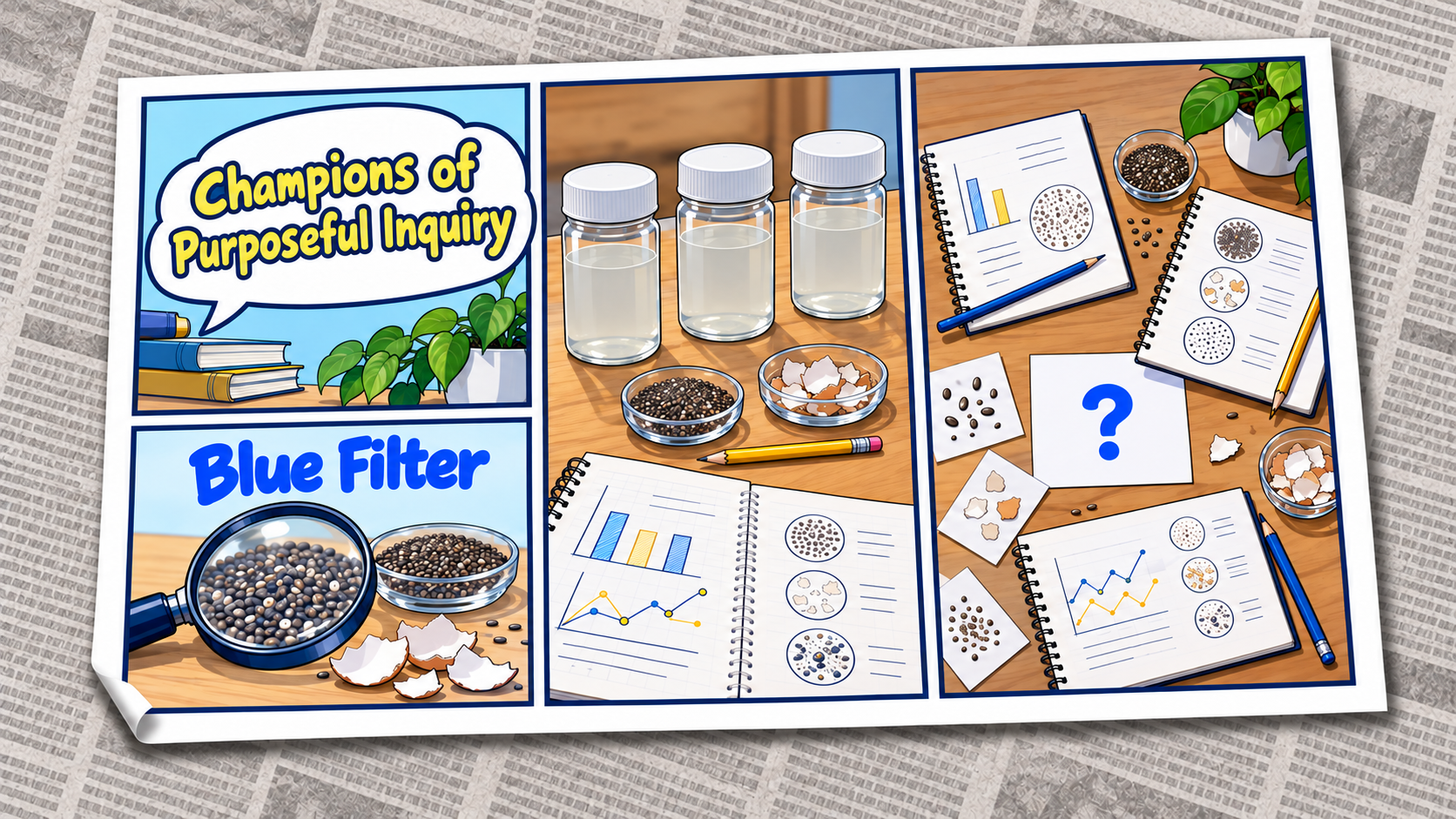
Conceptual illustration inspired by Blue Filter research. It does not depict a verified classroom scene or establish water-treatment safety.
What they made happen
“It is about empowering people to believe in their potential, develop their talents, overcome barriers, and create solutions that improve their communities.” For Salah El Sadi, that is the purpose of teaching. A scientific project matters not only for what it produces, but for the opportunity it gives people to develop and contribute ideas of their own.
In Palestine, Salah has connected science education with entrepreneurship training, leadership development and mentoring. Through work with local organizations and educational initiatives, he has helped young people identify community challenges and develop scientific projects and ideas to address them. His work continues through international networks and collaborations while he lives in the United States.
Blue Filter is one expression of that wider mission. The environmental venture grew from his own question about whether natural materials, particularly chia seeds, could help treat contaminated water in Gaza. Taking that question beyond his master’s research required him to learn, seek guidance and develop an idea with a practical purpose. Those commitments also shape his work with learners. [1]
Meet the educator
A Palestinian educator, environmental researcher and entrepreneur, Salah holds a bachelor’s degree in industrial chemistry and a master’s in water and environmental science. He is the founder and CEO of Blue Filter. [2]
His teaching has included science, chemistry and entrepreneurship at Imam Shafie Vocational School in Gaza, working with learners aged 14 to 19. His Global Teacher Prize profile describes student involvement in Blue Filter, innovation clubs, mentoring and teacher training. He was named a Top 50 finalist for the 2026 prize. [3]
Salah’s work with local organizations in Palestine has included mentoring young entrepreneurs and emerging leaders as well as school students. He remains committed to supporting young people in Gaza whose education, training and professional opportunities have been disrupted by war.
What went into it
Blue Filter began with Salah’s master’s research in water and environmental science at Al-Azhar University in Gaza. He was independently investigating chia seeds when, during laboratory work at the Islamic University of Gaza, he met Ahmed Gendia, who was researching eggshells. Their collaboration was academic, focused on water contamination. Ahmed was a research colleague, not a co-founder or business partner in Blue Filter.
Dr. Hassan Tammous and Dr. Khamis Al Mahllawi guided Salah’s research as his thesis supervisors. They are also his coauthors on a chapter published by Springer in March 2023, which describes laboratory work with nitrate solutions and groundwater samples. Their guidance contributed to the research; the decision to establish Blue Filter was Salah’s entrepreneurial initiative. [4]
He developed the venture’s name, business concept and identity. As founder and CEO, he continues developing the technology, building partnerships and seeking funding. University of St Andrews updates from 2021 describe laboratory setup, sample collection, testing, training and market surveys. SPARK documented entrepreneurship coaching and a $10,000 award at the 2022 IGNITE conference that supported equipment, licensing and further tests. [1] [5]
In 2023, the Fulbright Teaching Excellence and Achievement Program brought him to the University of North Carolina at Greensboro. He came to exchange teaching practices and share the experiences of Palestinian educators. When war began in Gaza that October, a temporary educational visit became a prolonged separation from home.
Salah describes the destruction of his family home and the pain of remaining apart from his family. He has continued mentoring, research and partnership-building while navigating uncertainty about his future. He says travel and re-entry constraints have prevented him from attending many international events where his work was to be shared or recognized.
Recognition has continued, including first place for Blue Filter in the Geneva Centre for Security Policy’s 2025 Prize for Innovation in Global Security. In the United States, his work as Director of Technology and Innovation at Inventions for Good connects research, partnerships and practical problem-solving with humanitarian needs. [6] [7]
He also describes supporting water distribution in Gaza through Blue Filter and local collaborators. Local teams carry out deliveries; Salah contributes through coordination, partnerships and available resources. Alongside the longer-term development of the technology, this work keeps his attention on the people he wants it to serve.
Why it matters
Salah’s story is about creating opportunities for people to develop what they can do. His teaching, mentoring and entrepreneurship bring together encouragement and demanding work: identifying a meaningful problem, gaining knowledge, seeking expertise and developing an idea. Believing in someone’s potential does not mean supplying the answer. It means helping them build the capacity to investigate.
Research offers a useful connection. University of Twente researchers Ard W. Lazonder and Ruth Harmsen synthesized 72 studies in a September 2016 Review of Educational Research meta-analysis. They found that guidance supported inquiry activities, task performance and learning outcomes. For educators, the implication is practical: give learners a meaningful question and help them work out what evidence would answer it. [8]
His personal circumstances are part of the story, not a standard others must meet. What educators can carry forward is his commitment to mentorship, encouragement and opportunities for people whose potential might otherwise go unnoticed.
Bring the idea to your classroom
Start by asking what your learners care about in their community. Choose a manageable environmental question and a published dataset that can help them investigate it. Model one interpretation, then invite groups to compare explanations and identify what the information cannot tell them.
Give their ideas an audience. Groups can prepare a short briefing for peers, respond to questions and revise their explanations. Ask each learner to name a contribution they made, something they learned to do and the support they would need for a next step.
This is a Champions of Learning adaptation, not a documented Blue Filter lesson. Use published data only. Do not collect unknown water, drink experimental water or claim that a classroom filter makes water safe.
The opportunity need not begin with a new invention. Begin with a question learners care about, provide the guidance to pursue it, and make room for them to recognize what they can contribute.
Help Me Try This
Download A Question Worth Testing: the two-page teacher guide (PDF)
Sources and credits
Salah El Sadi’s personal account, supplied November 7, 2026, informs the quotations, founder and collaborator roles, educational mission, Fulbright experience, family separation, travel constraints and humanitarian work.
[1] SPARK. “Gaza’s water purification startup wins $10,000 in seed funding.” August 7, 2023.
[2] Halcyon. Salah El Sadi, 2024 MENA Fellowship founder profile.
[3] Global Teacher Prize. Salah El Sadi profile, December 12, 2025; 2026 Top 50 finalists.
[6] Geneva Centre for Security Policy. 2025 Innovation Prize winners, November 25, 2025.
Champions of Learning · Story card
Champion of Purposeful Scientific Inquiry
Salah El Sadi
Palestinian educator, environmental researcher, and founder and CEO of Blue Filter
Editorial takeaway
Help learners recognize their potential, develop their ideas and contribute to their communities.
Explore more educator stories.