
Listen to this story · 6 min · narrated with AI voices
What they made happen
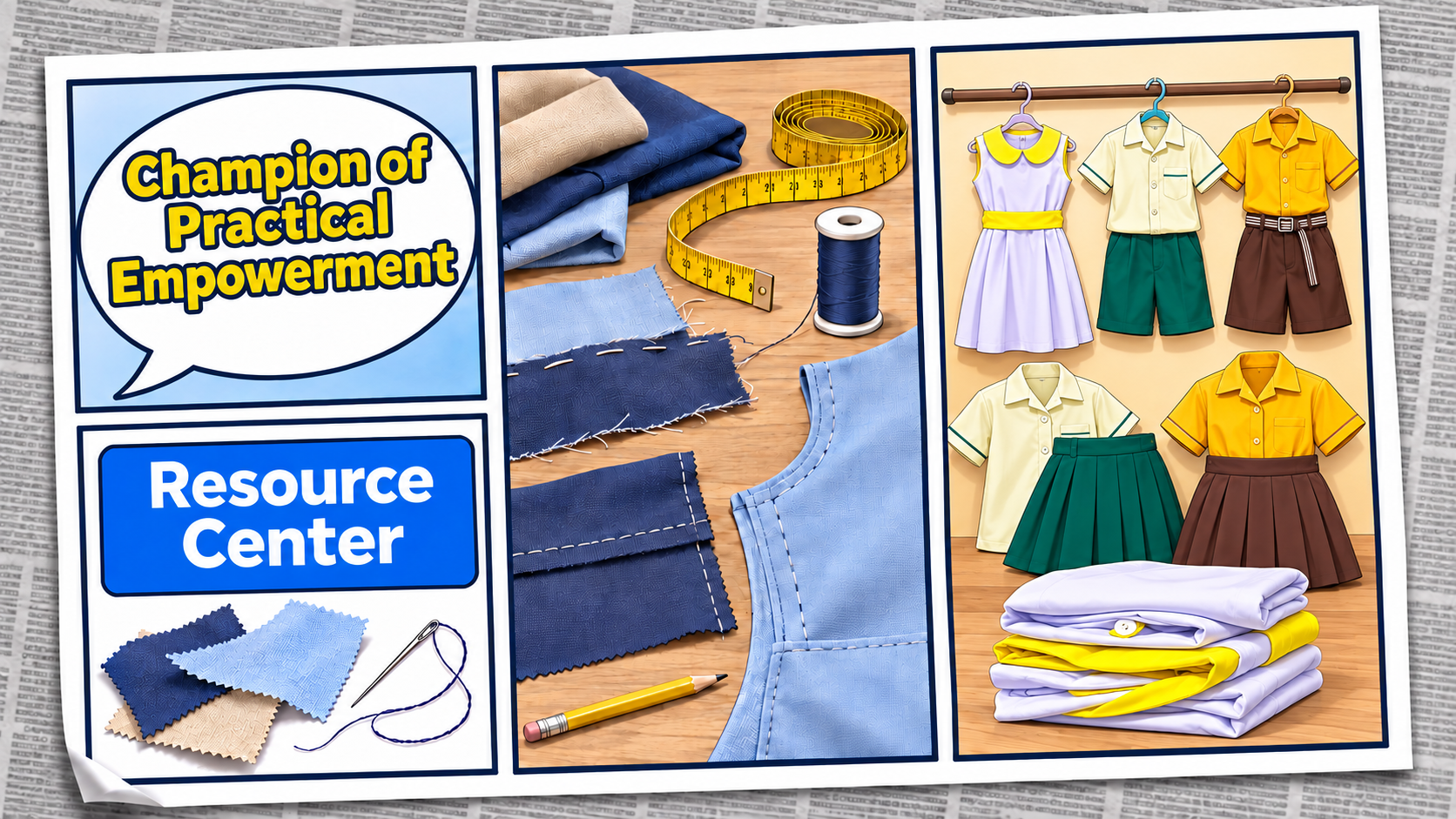
Jusinta Kwakyewaa, a Senior High School teacher in Ghana, established a dedicated clothing and textiles resource center alongside a free school uniform initiative for her students. Recognizing that the cost of school uniforms presents a persistent financial barrier for families in her community, Kwakyewaa personally invested approximately US$2,300 to renovate an old block, purchase sewing tools and equipment, fabric and essential haberdashery supplies to furnish the renovated training space [1].
Through this initiative, Kwakyewaa provides students with hands-on vocational instruction in garment construction and textile care while simultaneously producing free uniforms for children who lack them. By addressing both practical skill development and immediate material needs, her project directly supports school retention and alleviates family financial burdens in the local community.

Meet the educator
Jusinta Kwakyewaa works as a Senior High School educator in Ghana, specializing in home economics education (clothing and textiles). Operating in a community where local families frequently face economic constraints, she identified that missing or worn uniforms often discouraged children from attending school regularly or led to social exclusion.
Driven by a commitment to practical empowerment, Kwakyewaa expanded her teaching beyond standard classroom lectures to create a practical, workshop-based learning environment. Her efforts earned international recognition when she was named a Top 50 finalist for the 2026 Global Teacher Prize, organized by the Varkey Foundation [1].
What went into it
Establishing the clothing and textiles resource center required substantial planning, resource allocation, and community coordination. Kwakyewaa funded the initial purchase of equipment and raw materials independently, securing sewing tools and equipment to build the workshop from the ground up.
The operational process involved several key steps:
- Setting Up the Workshop: Renovating a dedicated school space and furnishing it with sewing tools, equipment, fabric and haberdashery supplies.
- Integrating Practical Instruction: Giving students hands-on practice in garment construction and textile care as part of their clothing and textiles lessons. Her prize profile credits the center with helping more than 4,000 students gain hands-on skills [1].
- Targeted Uniform Distribution: Identifying students in severe financial need and coordinating the production and free distribution of tailored school uniforms to ensure they can attend class with dignity.
Throughout the process, Kwakyewaa engaged key stakeholders, collaborating with school administrators, parents, and local organizations such as the Frans Care for All Networks to sustain supplies and expand community support [1]. Jusinta also acknowledges Gloria Afua Nyarko and Simon Tettey Akutei, members of her foundation, Frans Care For All Networks.
Why it matters
Kwakyewaa’s prize profile names poverty-driven dropout and absenteeism among the challenges she works to overcome while teaching in rural Ghana [1]. By embedding uniform production directly within a vocational learning curriculum, Kwakyewaa transforms a potential point of exclusion into an opportunity for skill acquisition and community care.
This grassroots approach connects with research on school uniform programs in sub-Saharan Africa. In a 2009 World Bank working paper, David Evans, Michael Kremer, and Mũthoni Ngatia studied a program in western Kenya that used a lottery to distribute free uniforms to primary school students. J-PAL summarizes the finding as a drop in absenteeism of 6.4 percentage points from a baseline of 15 percent [2]. While this study evaluates an organization's uniform distribution rather than Kwakyewaa's teacher-led textile lab, it offers evidence that removing uniform costs can improve student participation.
Bring the idea to your classroom
Editorial note: The following steps represent an editorial adaptation of Jusinta Kwakyewaa's resource-building and peer-support model for standard classroom environments.
- Identify Material Learning Barriers: Conduct a low-stakes audit with school counselors or staff to identify minor physical barriers (such as missing school supplies, winter accessories, or uniform items) that affect student attendance or confidence.
- Establish a Practical Repair or Skill Station: Create a hands-on service project within a practical arts, CTE, or life-skills class where students learn basic repair skills (such as sewing buttons, mending seams, or refurbishing supplies) to support school needs.
- Partner with Local Networks: Collaborate with parent-teacher groups or community organizations to secure donations of raw materials, tools, or fabric scraps, ensuring the program remains self-sustaining.
Help Me Try This
Download the teacher adaptation guide (PDF). A Champions of Learning adaptation inspired by this work.
Sources and credits
[1] Global Teacher Prize / Varkey Foundation, 2026 Finalist Profile: Jusinta Kwakyewaa, December 8, 2025. Award nomination profile detailing the clothing and textiles resource center, uniform initiative, personal financial investment, and community partners.
[2] David Evans, Michael Kremer, and Mũthoni Ngatia, “The Impact of Distributing School Uniforms on Children’s Education in Kenya,” World Bank working paper, November 2009. Read the J-PAL evaluation summary.
Champions of Learning · Story card
Champion of Practical Empowerment
Jusinta Kwakyewaa
Senior High School Textiles Educator | Ghana
Editorial takeaway
Removing physical barriers to education while teaching practical life skills turns the classroom into a vital engine for community equity and student dignity.
Explore more educator stories.


